

Case Study
AI-Powered Sales Intelligence System for a B2B Enterprise Software Company

Industry
B2B Software / SaaS
Core Technologies
DatabricksDelta LakeGenieSQLUnity Catalog
Challenges
The company's sales organization was large and distributed, and pipeline visibility depended on a mix of dashboards and analyst-built reports that didn't talk to each other. A simple question like "how is the enterprise segment tracking against quota this quarter" meant either bouncing between multiple dashboards or waiting on an analyst to pull a custom report.
As the sales org scaled, this became a bottleneck at the leadership level. Requests that should have taken minutes were taking hours, and inconsistent metric definitions across teams meant two dashboards could show two different "pipeline" numbers for the same quarter. Leaders began asking fewer questions rather than chasing down answers.
The company had already tried to solve this once, with an off-the-shelf AI reporting tool. It hallucinated numbers and mixed up segments during a live leadership meeting, and adoption stalled immediately after. Going into this engagement, the requirement wasn't just "an AI tool that answers questions" — it was one where every answer could be verified against real data, on the spot.
Solution
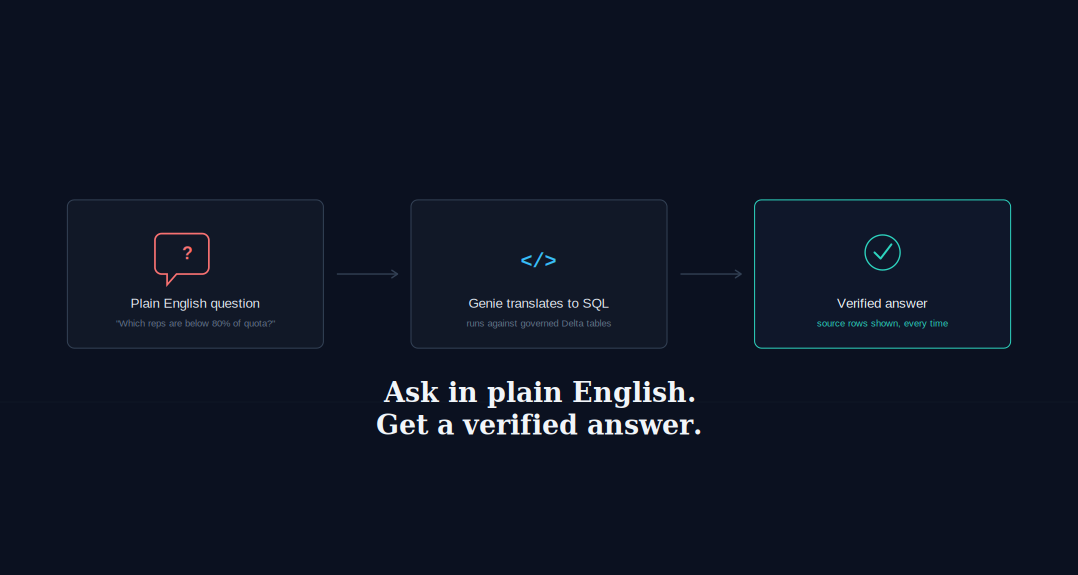
Our Expert Databricks Developers collaborated with the company's sales operations team to design a governed, natural-language pipeline intelligence system built entirely on Databricks — one where the AI layer never generates a number itself, only translates the question into a query that runs against real data.
We began with a structured discovery phase: reviewing the existing deal and rep datasets, identifying the metrics leadership actually cared about (quota attainment, pipeline coverage, win rate), and mapping where past AI-driven reporting had gone wrong. This shaped a strict design rule for the entire system — the language model's only job is producing the query, never stating the answer.
The system includes:
- A medallion pipeline (bronze → silver → gold) on Delta Lake that cleans, deduplicates, and standardizes deal and rep data before it's ever queried
- Unity Catalog governance over all sales tables, with column-level metadata, accepted-value dictionaries, and access controls
- Certified Metric Views for quota attainment, pipeline value, and win rate, so every team gets the same number from the same formula, every time
- A Databricks Genie Space as the natural-language interface, scoped narrowly to the governed sales tables and seeded with verified example question-to-SQL pairs
- A deterministic validation layer that flags incomplete data, ambiguous time periods, or unavailable metrics instead of letting the model guess
- A chat interface that always displays the generated SQL and underlying rows alongside the answer, so any result can be checked in seconds
We validated the system with real sales leaders across multiple question types before rollout, specifically testing edge cases similar to what broke the previous AI tool — ambiguous time periods, missing data fields, and segment mix-ups.
The solution now runs as the primary way sales leadership interacts with pipeline data, with human analysts freed up for genuinely custom, judgment-based analysis rather than routine lookups.
Technologies and Tools
Platform
Databricks Lakehouse, Unity Catalog
Data Layer
Delta Lake, medallion architecture (bronze/silver/gold)
Natural Language Interface
Databricks Genie
Governance
Unity Catalog Metric Views, column-level metadata, access controls
Cloud Hosting
AWS
Results

Time to answer for common pipeline questions dropped from hours to minutes, with leaders self-serving directly instead of routing through analysts.
Metric inconsistency across teams was eliminated — quota attainment, pipeline value, and win rate now compute identically everywhere they're referenced.
Every answer surfaces its source SQL and underlying rows, rebuilding leadership trust after the prior AI tool's hallucination incident.
Ambiguous or incomplete-data questions are now flagged explicitly instead of silently answered, catching real data gaps early.
Analyst time previously spent on routine pipeline lookups was freed up for higher-judgment analysis.
Words of Appreciation
"After our last AI tool got numbers wrong in front of the whole leadership team, nobody wanted to touch this again. What changed our minds was seeing the actual query behind every answer. Now our regional leads ask pipeline questions directly instead of waiting on my team, and I finally trust what comes back."
John K
VP of Sales Operations

Got a Technical Challenge?
Let's Talk