

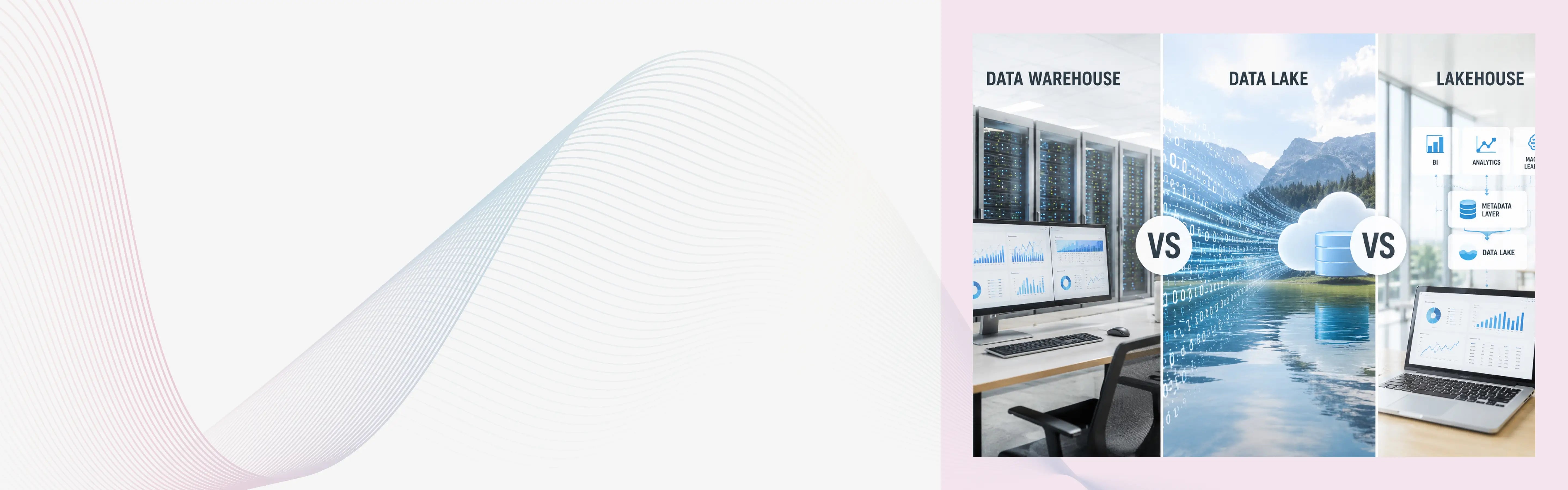
Every data pipeline eventually delivers data somewhere. That somewhere determines everything else about your platform: how fast analysts can query it, how much it costs to maintain, whether your machine learning models can access the raw data they need, and whether governance and compliance are possible at scale.
Get the architecture wrong and you pay for it for years. An overly rigid warehouse blocks your data science team. An ungoverned data lake becomes a swamp that no one trusts. A lakehouse implemented without proper planning compounds both problems at once.
The decision is also now a board-level concern. According to Monte Carlo Data's January 2026 enterprise data platform analysis, 81% of IT leaders say their C-suite has mandated no additional spending or a reduction of cloud costs. Data teams need to balance the need for robust, powerful data platforms with increasing scrutiny on costs. Every architecture choice now has a direct line to a finance conversation.
This article is part of a series starting with Modern Data Engineering: The Complete Guide, which covers the full landscape of tools, platforms, and decisions in data engineering for 2026.
What Is a Data Warehouse and How Does It Work?
A data warehouse is a centralized repository designed to store structured, processed data from multiple source systems and make it fast and reliable to query.
Think of it like an actual warehouse. When goods arrive, they are sorted, catalogued, and placed in specific sections on specific shelves. You always know exactly where something is. When you need it, retrieval is fast and predictable. But bringing in something that does not fit the existing shelf format takes significant preparation first.
Data warehouses operate on a model called schema-on-write. This means the structure of the data is defined before anything is loaded. Every field has a type, every table has a defined shape, and data is cleaned and transformed to match that structure during the ingestion process (typically through ETL). Only data that conforms to the schema can enter.
As IBM's data storage architecture guide explains, data warehouses aggregate data from disparate sources in a single store, applying a consistent schema to all data as it is written to storage. This promotes data consistency, which makes data more reliable and easier to work with.
Where Data Warehouses Excel
Data warehouses are purpose-built for business intelligence and reporting. When a finance team needs quarterly revenue by region, when an operations team tracks inventory turnover over 18 months, or when a marketing team pulls campaign performance against historical benchmarks, the warehouse delivers fast and trustworthy answers.
Well-known warehouse platforms include Snowflake, Amazon Redshift, Google BigQuery, and legacy on-premise systems like Oracle and Teradata. Data.folio3's February 2026 data engineering statistics report confirms that over 90% of mid-to-large organizations use a cloud data warehouse in 2026, marking near-universal adoption among enterprise teams.
Where Data Warehouses Break Down
The warehouse model has three structural limitations that modern data teams run into constantly.
First, cost at scale. Warehouses store data in proprietary formats with compute and storage tightly coupled. As data volumes grow, costs grow with them. You cannot simply store everything and figure out the schema later.
Second, inflexibility with unstructured data. Traditional warehouses are built for structured, relational data. They struggle badly with images, video, audio, raw logs, JSON documents, and the kinds of semi-structured and unstructured data that machine learning models need. As IBM notes, some modern warehouses have evolved to accommodate semi-structured and unstructured data, but many organizations prefer lakes and lakehouses for these data types.
Third, schema rigidity as a pipeline bottleneck. Every time a source system changes its data format, the warehouse schema must be updated before new data can land. For teams building pipelines that ingest from dozens of fast-changing sources, this creates a constant maintenance burden.
What Is a Data Lake and How Does It Work?
A data lake is a storage repository that holds large amounts of raw data in its native format, regardless of structure, until it is needed.
Think of it as an actual lake. Water flows in from many tributaries in many forms: rain, rivers, snowmelt. The lake stores all of it without filtering or sorting. When you want water for a specific purpose, you extract what you need and process it at that point.
Data lakes operate on a model called schema-on-read. No schema is required before data lands. You store everything raw and only define structure when you actually query the data. This makes ingestion fast and cheap.
As Striim's cloud data storage patterns overview describes, data lakes emerged to handle raw data in various formats on cheap object storage for machine learning and data science workloads. The most common storage backbone is cloud object storage: Amazon S3, Azure Data Lake Storage, or Google Cloud Storage, where you pay for only what you store and can hold exabytes cost-effectively.
Where Data Lakes Excel
Data lakes are the right choice when flexibility and raw data preservation are the priority. Data scientists who need access to granular, unmodified data for feature engineering. Teams ingesting image files, sensor streams, clickstream logs, and application events that have not yet been defined into a schema. Any use case where you need to store first and decide how to use the data later.
Data lakes are also open format. Files are typically stored in Apache Parquet, ORC, or other open formats, which means no proprietary vendor lock-in. Multiple compute engines can read the same files.
Where Data Lakes Break Down: The Data Swamp Problem
Data lakes fail in a very specific and well-documented way. Without governance, they become data swamps.
As Medium's Modern Data 101 January 2026 analysis describes it bluntly: in most organizations, the data lake became a "write-first, think-later" environment. Anyone could drop in files, but no one felt responsible for what happened next. Without clear ownership or validation rules, data pipelines broke silently, schemas drifted over time, and duplicates crept in. Ultimately, quality issues compounded until the data itself lost credibility.
TechTarget's data lake governance analysis frames it clearly: if a data lake is not well managed and governed, it can become more of a swamp than a lake. Data is dumped into the platform without suitable oversight and documentation, making it difficult for governance teams to keep track of what is in the lake. That can cause problems with data quality, consistency, reliability, and accessibility. Even worse, a data swamp can lead to analytics errors and bad business decisions.
The four specific technical problems a raw data lake cannot solve:
- No ACID transactions: If a write job fails halfway through, you end up with partial, corrupted data files with no rollback mechanism.
- No schema enforcement: Nothing stops a source system from changing its data format and silently corrupting all downstream queries.
- No concurrency control: Two jobs writing to the same location at the same time can corrupt each other's output.
- No query performance optimization: Plain files in object storage have no indexing, no statistics, and no predicate pushdown. Every query scans everything.
SOLIX's January 2026 data lake architecture analysis identifies the root cause as "governance inversion": ingestion is self-service, but accountability is centralized. The platform accumulates unmanaged datasets faster than they can be classified and maintained. The constraint is organizational behavior under deadline pressure: teams optimize for shipping data, not for naming, retention labeling, and ownership assignments.
Side-by-Side Comparison: Data Warehouse vs Data Lake
Before introducing the lakehouse, it helps to see the warehouse and lake tradeoffs as a direct comparison.
| Dimension | Data Warehouse | Data Lake |
|---|---|---|
| Data types supported | Structured only | Structured, semi-structured, unstructured |
| Schema model | Schema-on-write (defined before load) | Schema-on-read (defined at query time) |
| Storage format | Proprietary, optimized for the platform | Open formats (Parquet, ORC, CSV, JSON) |
| Storage cost | Higher (compute and storage coupled) | Lower (cheap cloud object storage) |
| Query performance | Fast for structured SQL analytics | Slow without optimization layers |
| ACID transactions | Yes, built-in | No, not by default |
| Data governance | Strong, schema-enforced | Weak without additional tools |
| Best for | BI, reporting, structured analytics | ML, data science, raw data archiving |
| Main failure mode | Too rigid, too expensive at scale | Becomes a data swamp without governance |
What Is a Lakehouse and Why Did It Win?
The lakehouse is the architecture that solves both problems at once. It was coined and popularized by Databricks and is now the dominant model for modern enterprise data platforms.
The core idea: store all your data (structured and unstructured) in open-format cloud object storage, exactly like a data lake. Then add a transactional metadata layer on top that brings ACID transactions, schema enforcement, indexing, and governance, exactly like a data warehouse. You get the storage economics of a lake and the reliability and performance of a warehouse from one unified system.
As MotherDuck's April 2026 architecture guide puts it directly: a lakehouse is essentially a data lake that has grown up, gaining the management features necessary for enterprise business intelligence. The key innovation is a transactional metadata layer built on top of data stored in open file formats, using open table formats like Apache Iceberg, Delta Lake, or Apache Hudi to manage data files in inexpensive cloud object storage.
According to Databricks' data lake vs warehouse analysis, lakehouse platforms combine the scale and flexibility of a data lake with the reliability and performance of a data warehouse. Rather than managing and integrating separate systems, teams can work on a single, governed copy of the data, whether for SQL queries, machine learning models, or streaming pipelines.
What the Lakehouse Eliminates
The lakehouse removes the most painful costs of running both a warehouse and a lake in parallel.
- Data duplication: With a two-system architecture, data gets copied from the lake into the warehouse for analytics. Every copy creates consistency risk, additional storage cost, and pipeline complexity. The lakehouse serves both workloads from the same data.
- Pipeline sprawl: Maintaining separate ingestion pipelines for the lake and the warehouse means double the engineering work. One system means one set of pipelines.
- Sync failures: When the lake and warehouse fall out of sync, teams get inconsistent metrics. Different dashboards show different numbers for the same question. The lakehouse eliminates this by definition: there is only one copy of the data.
As IBM explains, differences in schema enforcement, data processing pipelines, and transaction support can cause the lake and warehouse to fall out of sync, resulting in inconsistent metrics and a lack of a single, trusted source of truth. The lakehouse solves this at the architecture level.
Is Your Data Lake Turning into an Untrustworthy Data Swamp?
Stop paying for rigid silos or ungoverned storage. Hire experienced data engineers to migrate your data estate into a clean, ACID-compliant Lakehouse architecture.
The Lakehouse in Numbers: 2026 Market Reality
The lakehouse model is not a theoretical ideal. It is already the direction the market has moved.
According to data.folio3's February 2026 data engineering statistics report, over 50% of data teams are now implementing lakehouse patterns, and Apache Iceberg adoption is accelerating as the open table format standard enabling multi-engine data access.
The market numbers reflect this shift. Global Market Insights values the global data lakehouse market at $11.9 billion in 2024 and forecasts growth to $105.9 billion by 2034 at a 25% compound annual growth rate. Future Market Insights projects the market to reach $112.6 billion by 2035, representing an 8x increase from the 2025 baseline of $14 billion.
Databricks, the company that coined the term lakehouse and built the architecture around Delta Lake and Apache Spark, reached a $134 billion valuation in 2026 according to Pebblous's April 2026 strategic analysis, with $5.4 billion in annual recurring revenue and its fastest growth period ever. The dual drivers are AI demand explosion and the broad enterprise transition from two-system (lake plus warehouse) architectures to unified lakehouses.
How the Lakehouse Handles What Neither the Warehouse nor the Lake Could
The lakehouse architecture does not just combine the two older models. It solves specific technical failures that neither system could address alone.
ACID Transactions on Object Storage
The biggest technical achievement of the lakehouse is bringing ACID transactions to cloud object storage. This is what Delta Lake, Apache Iceberg, and Apache Hudi accomplish. As Striim explains, data lakehouse architectures usually start as data lakes containing all data types. The data is then managed with a format like Delta Lake that brings ACID transactional processes from traditional data warehouses directly to the data lake files.
What ACID transactions mean in practice: writes either fully complete or fully roll back. If a pipeline fails halfway through updating a table, the partial write is discarded automatically. Readers never see corrupted or incomplete data. Two concurrent writes to the same table do not conflict. This is not possible in a plain data lake.
Delta Lake Explained for Data Engineers covers how Delta Lake implements ACID guarantees through a transaction log, how time travel works to query historical snapshots, and how Change Data Feed tracks row-level changes. These features are what make the lakehouse viable for production workloads that the data lake alone could never handle reliably.
Schema Enforcement Without Rigidity
The lakehouse enforces schema at write time, rejecting data that does not match the expected structure. This prevents the silent schema drift that destroys data lakes over time.
But it does so without the rigidity of a traditional warehouse. When a source schema changes legitimately, the lakehouse can handle schema evolution: adding new columns, changing nullable constraints, and propagating changes through the pipeline without requiring a full rebuild. The warehouse forced you to redesign the ETL pipeline. The lake accepted the change silently and broke downstream queries. The lakehouse enforces the rules but bends gracefully when the rules legitimately need to change.
Unified Analytics and AI Workloads on the Same Data
This is the defining advantage in 2026. The lakehouse serves SQL analysts and data scientists from the same data, in the same system.
A BI analyst running a Databricks SQL query against the Gold layer tables gets the same data that the ML engineering team uses to train models from the Silver layer. No copies. No synchronization lag. No "which system has the right answer" conversation.
As Revefi's March 2026 Databricks growth analysis notes, Databricks is now extending this further with Lakebase (a serverless PostgreSQL database for AI agents built inside the lakehouse) and Genie (a natural language query interface that lets business users ask questions without SQL expertise). The lakehouse is becoming the single platform for every data workload: engineering, analytics, machine learning, and AI.
Three-Way Architecture Comparison
| Dimension | Data Warehouse | Data Lake | Lakehouse |
|---|---|---|---|
| Data types | Structured only | All types | All types |
| Schema model | Schema-on-write | Schema-on-read | Both, with enforcement |
| ACID transactions | Yes | No | Yes |
| Storage cost | High | Low | Low (object storage) |
| Query performance | High | Low without tuning | High with Delta/Iceberg |
| Data governance | Strong | Weak | Strong (Unity Catalog) |
| ML and AI support | Limited | Good for raw data | Full, native support |
| Open standards | No (proprietary) | Partially | Yes (Delta, Iceberg, Parquet) |
| Best for | BI and reporting | Raw storage, exploration | All workloads unified |
| Main risk | Cost and rigidity at scale | Data swamp without governance | Complexity if implemented poorly |
When Does Each Architecture Still Make Sense in 2026?
The lakehouse is the best default architecture for most teams starting fresh or modernizing in 2026. But there are situations where the older models still make practical sense.
When to Keep a Data Warehouse
A standalone data warehouse still makes sense when your team is entirely focused on structured SQL analytics with no machine learning or unstructured data requirements, when your existing warehouse investment is mature and performing well and migration cost exceeds the benefit, or when you operate in a tightly regulated environment where your compliance framework was built around a specific warehouse platform.
When a Data Lake Is Still Part of the Architecture
Most lakehouses include a data lake layer as their foundation. Raw, Bronze-layer data lands in open-format object storage first. The lakehouse governance layer sits on top. So in practice, most modern architectures still include a lake. They just add the reliability and governance layer that transforms it from a swamp risk into a managed foundation.
Pure lakes without governance layers are mainly used as low-cost archival stores or as staging zones before data enters the lakehouse proper.
When the Lakehouse Is Clearly the Right Choice
The lakehouse is the right architecture when your team has both analytics and data science workloads drawing from the same data, when you need governance and data quality across all data types, when you want to eliminate the cost and complexity of maintaining two separate systems, or when you are building for AI and machine learning workloads that need clean, governed, raw-accessible data in one place.
What Is Lakehouse Architecture covers the full technical design of the lakehouse model in depth: the storage layer, the metadata layer, the query engine, the governance layer, and how Medallion Architecture organizes data inside a lakehouse from raw Bronze through production-ready Gold. It is the right next step after this article if you want to understand the architecture before deciding to adopt it.
How Databricks Implements the Lakehouse
Databricks did not just coin the term "lakehouse." It built the technical foundation that makes it work in production.
The Databricks lakehouse is built on three open-source technologies that Databricks created or co-created: Delta Lake (the transactional storage layer), Apache Spark (the distributed compute engine), and MLflow (the machine learning lifecycle platform). Unity Catalog provides governance across all three, handling access control, data lineage, auditing, and discovery for every asset in the lakehouse.
What Is Databricks and Why Data Teams Use It covers the full platform in depth, including how the architecture maps to real engineering workflows, what Lakeflow brings to pipeline development, and why teams choose Databricks over Snowflake and other competing platforms.
For teams specifically asking how Databricks SQL compares to a traditional data warehouse for analytics workloads, the performance, cost, and architectural differences are covered in detail in Databricks SQL vs Traditional Warehousing. That article is the direct continuation of the warehouse vs lakehouse comparison that this article introduces.


