

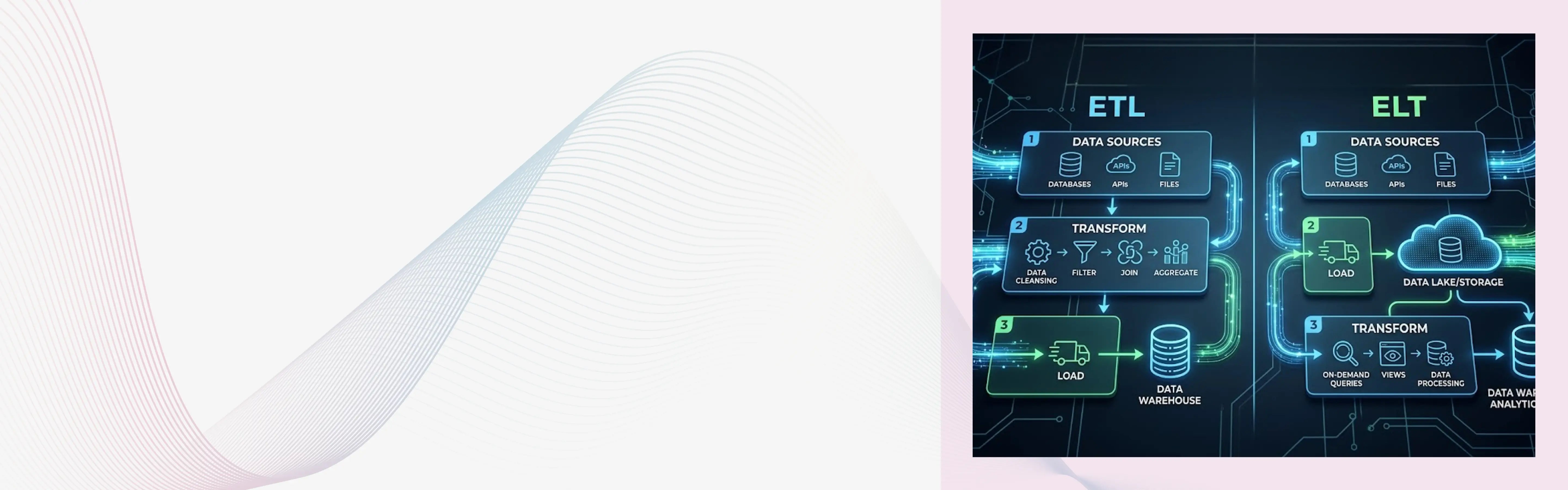
ETL and ELT describe the same three operations: Extract, Transform and Load. You pull data from a source, you do something to it and put it somewhere useful. The acronyms only differ by one letter. But that one letter changes the entire architecture of your pipeline.
The sequence is everything.
As Databricks explains in their official ELT vs ETL breakdown, both processes are ultimately geared toward the same goal: effective data management. What differs is where and when the transformation step happens, and that difference reshapes every downstream decision about tools, infrastructure, cost, and flexibility.
If you are not yet familiar with how pipelines are structured in general, How Modern Data Pipelines Actually Work covers the four core stages every pipeline goes through before you layer ETL or ELT patterns on top of them. And for the full context of why these patterns exist in the first place, Modern Data Engineering: The Complete Guide is your starting point.
How ETL Works: Extract, Transform then Load
ETL is the older pattern. It was designed for a world where storage was expensive and compute lived outside the warehouse.
Here is the flow:
- Extract: Pull raw data from source systems. Databases, files, APIs and SaaS applications.
- Transform: Send that raw data to a separate processing engine. Apply your cleaning logic, join rules, and format changes there. Only the output of that processing gets passed forward.
- Load: Load the already-cleaned, already-transformed data into your destination warehouse or database.
The transformation happens in the middle, on a dedicated server or processing engine that sits between the source and the destination. Only structured, validated data ever enters the warehouse.
As Coalesce notes in their January 2026 ETL vs ELT comparison, this model worked well for earlier enterprise needs. It allowed data engineers to clean, join, and enrich data before it reached the analytics layer. It also made data governance relatively clear: the warehouse only ever held clean, approved data.
Why ETL Worked Well in the On-Premise Era
In the on-premise data warehouse era, storage was expensive and compute inside the warehouse was limited. Oracle, Teradata and SQL Server warehouses had real constraints on how much processing they could handle. Running heavy transformation jobs inside them was slow and costly.
It made more sense to do the heavy work outside and bring only the results in. ETL tools like Informatica, Talend and SSIS were built exactly for this purpose.
The tradeoff was complexity. Every ETL pipeline required a dedicated transformation server, a separate compute layer to manage, and tightly coupled logic that was hard to change when business requirements shifted.
ETL vs ELT: A Direct Comparison
The table below summarizes the core differences across the dimensions that matter most when choosing between the two patterns.
| Dimension | ETL | ELT |
|---|---|---|
| Transform location | External processing engine, before load | Inside the destination system, after load |
| Raw data preserved | No, only transformed output is stored | Yes, full raw data stays in storage |
| Scalability | Harder to scale, tied to transformation server capacity | Scales with cloud compute on demand |
| Speed to ingest | Slower, transformation is a blocker | Faster, raw data lands immediately |
| Compliance and masking | Strong, data can be masked before it ever lands | Requires governance controls inside the destination |
| Best tools | Informatica, Talend, SSIS, AWS Glue (legacy use) | dbt, Databricks Lakeflow, Spark, native SQL |
| Best for | Regulated industries, legacy systems, pre-load masking | Cloud-native platforms, large volumes, analytics and AI |
| Data quality control | At transformation time, before load | Post-load, requires testing frameworks like dbt |
When ETL Is Still the Right Choice in 2026
ELT dominates modern cloud-native architectures. That does not mean ETL is irrelevant. There are real situations where ETL remains the correct pattern, and getting this wrong has consequences.
Regulated Industries with Pre-Load Data Masking Requirements
If your data contains personally identifiable information (PII), financial records, or protected health information, you may be legally required to mask, encrypt, or anonymize that data before it enters any storage system. GDPR and HIPAA compliance, for example, can require that certain fields never land in a cloud warehouse in their raw form.
As Ortem Tech's March 2026 ETL vs ELT guide explains, sensitive data requiring pre-load masking is one of the clear cases where ETL is the safer choice. If data contains PII, financial records, or health data, you may need to mask, encrypt, or anonymize before it enters the warehouse to comply with GDPR, HIPAA or internal data governance policies.
Attempting to handle this in ELT puts raw sensitive data in storage first, even temporarily. For many organizations, that creates unacceptable risk.
Legacy On-Premise Warehouses with Limited In-Database Compute
Not every organization has moved to the cloud. Oracle, Teradata, and legacy SQL Server warehouses have limited in-database compute. Transforming large datasets inside them is slow and expensive.
For pipelines that feed these systems, ETL still makes technical sense. Transforming data externally and loading only the results is faster and cheaper than asking the warehouse to do the heavy lifting it was not built to handle.
Complex Transformations That Need Non-SQL Logic
Some transformation requirements cannot be expressed in SQL. Machine learning feature engineering, natural language processing and computer vision preprocessing need Python libraries that run outside the warehouse.
For these use cases, the transformation must happen in an external engine anyway. ETL is the natural fit.
When ELT Is the Right Choice in 2026
Ortem Tech's 2026 guide states it plainly: in 2026, ELT has become the default for most modern data stacks. For teams building on cloud-native platforms, the case for ELT is strong across several dimensions.
You Need Raw Data Available for Multiple Use Cases
One of the strongest arguments for ELT is data reusability. When you load raw data first, it is available in its original form for any downstream use case that emerges later.
Improvado's ETL vs ELT breakdown captures this well: organizations often do not know today which historical fields will matter tomorrow. ELT keeps raw detail intact, enabling retrospection and new analytic paths that were not anticipated when the pipeline was first built.
In ETL, once a field is dropped during transformation, it is gone unless you go back to the source. In ELT, the raw layer is always there.
Your Data Science Team Needs Granular Data for Machine Learning
SharpSkill makes a point that resonates with any team supporting ML work: ELT preserves every field, enabling data engineering teams to build feature stores directly from raw tables. Data scientists benefit from raw, detailed datasets for feature engineering, model training, and longitudinal behavior analysis.
Pre-aggregated ETL output often strips the granularity that makes ML possible. ELT avoids this by keeping raw data in place.
You Are Building in a Cloud-Native Environment with Fast-Changing Sources
Cloud-native architectures with elastic compute, managed orchestration and serverless transformation make ELT far easier to operate than ETL. When sources change their schemas, ELT pipelines can absorb the change at the raw layer without breaking downstream transformations immediately.
As dbt Labs' March 2026 data movement patterns guide describes, ELT enables a more organized data architecture with transformations performed directly in the warehouse, creating a streamlined and efficient process. Tools like dbt have emerged specifically to support this pattern, bringing software engineering best practices including version control, testing, documentation and modularity to the transformation layer.
Struggling to Choose Between ETL, ELT, or a Hybrid Stack?
Let's map out a scalable, compliant data architecture that fits your specific business goals.
How ELT Works on Databricks: The Lakehouse Model
Databricks is built for ELT. The entire lakehouse architecture is designed around the principle of landing raw data in open-format cloud storage, then transforming it at scale using distributed compute.
As Databricks explains in their official ELT resource, Databricks enables ELT by using the lakehouse as the central store where organizations land data and then apply scalable SQL and machine learning transformations. All three cloud platforms (AWS, Azure, GCP) support large-scale in-warehouse transformations central to ELT workflows.
The Standard ELT Stack on Databricks in 2026
In practice, the Databricks ELT pattern follows Medallion Architecture layers:
- Bronze layer: Raw data lands from Lakeflow Connect connectors or Auto Loader exactly as extracted. No transformations, no filtering.
- Silver layer: Lakeflow Spark Declarative Pipelines or dbt models clean, validate, and join raw Bronze data. Schema is enforced. Duplicates removed. CDC patterns applied.
- Gold layer: Business-ready aggregations and models are materialized for BI tools, Databricks SQL, and ML feature stores.
dbt Labs' ELT best practices guide for Databricks recommends using Databricks' COPY INTO functionality for Bronze layer ingestion from cloud storage, since COPY INTO operates incrementally and writes Delta format from the start, giving you reliability and governance advantages that plain parquet ingestion cannot match.
Real-World Results: What ELT on Databricks Actually Delivers
The results when teams make the switch are well documented. Explorium's case study on Databricks shows what this looks like in production. Their data engineers used to build ELT pipelines by writing Spark jobs in Scala or PySpark. Even with Apache Airflow for orchestration, the process was manual and slow. After moving to Databricks Lakeflow Jobs and dbt, they automated their most complex jobs throughout the Medallion Architecture. The outcome was real: they delivered new data products to their platform 10 times faster.
Coalesce's case study on Group 1001shows similar results. By modernizing their stack with Snowflake, Fivetran and Coalesce for ELT, the data engineering team cut iteration cycles from three months to just two days, with a 10x productivity boost.
These are not outlier results. They reflect a consistent pattern: teams that move from traditional ETL to cloud-native ELT spend less time managing transformation infrastructure and more time building things that matter.
The Role of dbt in Modern ELT Pipelines
No discussion of ELT in 2026 is complete without dbt (data build tool). It has become the standard transformation framework for ELT teams across every major cloud warehouse.
dbt runs SQL-based transformations inside the warehouse, not in a separate processing layer. As dbt Labs' March 2026 guide on ETL tools states, the architectural shift to cloud-native data warehouses has fundamentally changed where transformation should occur. Modern transformation tools like dbt represent the current state of the art, bringing software engineering best practices to data transformation through modular SQL models with version control, automated testing, and documentation.
What dbt solves that raw SQL scripts cannot:
- Modularity: Each transformation is its own model. Models reference each other. Change one and dbt handles the dependency chain.
- Testing: You define assertions in YAML. dbt runs them as SQL checks against your data. Bad data fails the pipeline before it reaches Gold.
- Documentation: Every model has a description. Column lineage is tracked automatically. New engineers can understand the data model without asking the person who built it.
- Version control: All transformation logic lives in Git. You can roll back a bad transformation the same way you would roll back a bad code deploy.
As Medium's January 2026 dbt and Databricks walkthrough puts it, the "black box" era of data engineering is over. The dbt plus Databricks combination shifts data engineering from opaque scripts to software-engineered, testable, documented data products.
The Hybrid Pattern: When You Need Both ETL and ELT
In practice, many production pipelines use both patterns together. This is not a compromise. It is a deliberate design choice.
A common hybrid pattern:
- Use ETL for the pre-load stage where PII or sensitive fields need to be masked or removed before reaching the lakehouse.
- Use ELT inside the lakehouse for everything that follows: cleaning, joining, aggregating, and serving.
As SharpSkill describes it, hybrid pipelines that mask PII during extraction and run analytics in the warehouse combine the strengths of both approaches. You get the compliance control of ETL and the scalability and flexibility of ELT.
This hybrid thinking defines modern data pipeline strategies across regulated industries where full ELT would create compliance risk but pure ETL would sacrifice the agility teams need.
ETL vs ELT: How Execution Patterns Connect to This Choice
The ETL vs ELT decision does not live in isolation. It intersects directly with how you handle data timing.
Batch pipelines are easier to implement with both ETL and ELT. You schedule a job, it runs, and you move on. Most analytics workloads operate fine on batch cadences.
Streaming pipelines change the equation. When data arrives continuously in real time, the pre-transformation step of ETL creates latency. Every event has to pass through the transformation engine before it lands, which slows the pipeline down. ELT handles streaming more naturally because raw events land immediately and transformation can happen downstream at its own pace.
Batch vs Streaming Pipelines covers this intersection in full depth, including how to decide which cadence your use case actually requires and how both batch and streaming pipelines are built on Databricks.
What Comes Next: Building Scalable ETL and ELT Pipelines on Databricks
Understanding the difference between ETL and ELT is foundational. The next step is knowing how to design these pipelines to be reliable, scalable and production-ready on Databricks specifically.
Designing Scalable ETL Pipelines on Databricks covers the implementation patterns for building transformation layers that handle real data volumes, schema evolution and operational requirements. That article builds directly on the concepts covered here.
For teams working with CDC (Change Data Capture) inside ELT pipelines, a related and advanced pattern is covered in Incremental Loads, CDC and Change Data Feed in Delta Lake. CDC is where ELT patterns get most powerful and most complex and Delta Lake's Change Data Feed feature is what makes it manageable at scale.
And for the broader picture of what Databricks is as a platform and why it is designed around ELT by default, What Is Databricks and Why Data Teams Use It is the right place to continue.


