

Enterprise AI has moved beyond simple chatbots and generic automation. Today, companies want AI systems that can answer questions using their own business data, internal documents, policies, product information, customer records, knowledge bases, and operational workflows.
That is where Retrieval-Augmented Generation, commonly known as RAG, becomes important.
RAG is not just another AI term. It is one of the most practical approaches enterprises are using to make large language models more accurate, relevant, and useful for real business environments. RAG is important to technical buyers, CTOs, CIOs, data leaders, and product teams because it addresses one of the biggest challenges in generative AI: how to enable AI to use your company’s real data rather than relying on general information from the internet. For that, you first need to understand how the RAG components work together to make it happen.
This article breaks down the core components of a RAG system from when a user types a query to the cited response and also explains how they fit together in a modern AI pipeline.
What is RAG in Simple Terms?
Retrieval-Augmented Generation (RAG) is an AI architecture that improves large language model performance by connecting the model to external knowledge sources. IBM describes RAG as a way to optimize AI model performance by linking it with external knowledge bases so LLMs can produce more relevant and higher-quality responses.
In a traditional LLM setup, the model generates answers based on what it learned during training. In a RAG setup, the model first retrieves relevant information from an external source, such as internal documents, databases, product manuals, policies, or knowledge bases. Then it uses that retrieved information to generate the final response. RAG gives the AI system a way to retrieve that knowledge before answering.
Why RAG Exists: The Problem It Solves
Large language models are remarkable, but they carry a fundamental constraint: their knowledge is frozen at the time of training. A model trained in 2023 knows nothing about events in 2026 unless explicitly updated. This creates several critical pain points:
| Problem | What Happens Without RAG | How RAG Solves It |
|---|---|---|
| Knowledge Cutoff | The model cannot answer about recent events | Retrieves current documents at query time |
| Hallucination | The model fabricates plausible-sounding but false facts | Grounds answers in verifiable source chunks |
| Domain Specificity | Model lacks expertise in niche proprietary domains | Connects to private knowledge bases and internal docs |
| Scalability of Knowledge | Retraining is expensive and time-consuming | Update the knowledge base, no need for retraining |
| Traceability | Hard to know why a model gave an answer | Retrieved sources can be shown as citations |
The Core Components of a RAG System
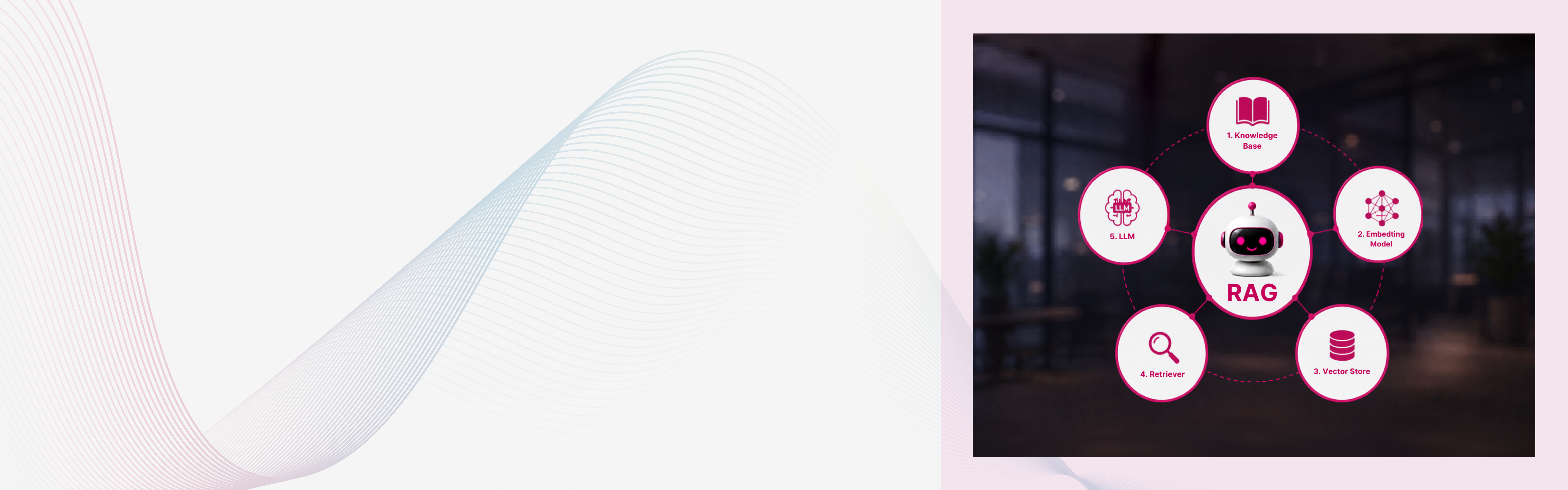
A fully functional RAG system has five distinct layers. They run in sequence, and each one depends on the one before it doing its job correctly.
1. The Knowledge Base (Your External Data Source)
Before anything retrieval-related can happen, there has to be something to retrieve. The knowledge base is the external corpus of information the RAG system draws from, and it's what makes RAG fundamentally different from a standard LLM response.
This corpus can be almost anything:
- Internal company documents, PDFs, wikis, and SOPs
- Product catalogs or pricing sheets
- Customer support ticket histories
- Legal contracts or compliance documentation
- Real-time feeds like news APIs or database tables
The quality and structure of this data have a direct impact on RAG output quality. Messy, duplicated, or poorly formatted documents create retrieval problems that no amount of prompt engineering will fix downstream. This is a point most teams underestimate — RAG data preparation is genuinely foundational, not an afterthought. According to NVIDIA's technical documentation on RAG, the ingestion and chunking strategy for source documents is one of the most consequential decisions in the entire pipeline design.
2. Document Chunking and Preprocessing
Raw documents are usually too long for efficient retrieval and embedding. So RAG systems break them into smaller chunks.
Common chunking strategies include:
- Fixed‑size chunks: Slices of 256, 512, or 1024 tokens, regardless of sentence structure.
- Sentence‑ or paragraph‑based chunks: Respects linguistic boundaries.
- Semantic chunking: Uses models to find semantically meaningful boundaries.
- Sliding‑window or hybrid approaches: Overlap chunks to preserve context.
Good chunking directly impacts search quality. If a question spans multiple paragraphs, a RAG system that understands document structure will return more coherent answers.
Beyond chunking, preprocessing steps such as:
- Removing boilerplate (headers, footers, navigation text)
- Cleaning whitespace and special characters
- Adding metadata (document title, section heading, URL)
helps downstream search and retrieval.
3. The Embedding Model
After documents are cleaned and chunked, the next component is embeddings. Embeddings are numerical representations of text. They help AI systems understand semantic meaning. Instead of searching only for exact keyword matches, embeddings allow the system to find content that is conceptually similar to the user’s question.
For example, a user may ask, “How can I reset my account access?” The document may say, “Steps to recover login credentials.” Keyword search may miss this match, but embedding-based search can understand that both phrases are related.
In RAG, both user queries and document chunks are converted into embeddings. The system then compares them to find the closest matches. Embedding quality matters because it affects how well the system understands user intent. Different embedding models may perform better for different domains, languages, and document types. For enterprises working with specialized content (legal, medical, financial), domain-specific fine-tuned embedding models often outperform general-purpose ones by a significant margin.
4. The Vector Database: Storing Knowledge for Retrieval
Once documents are chunked and embedded, those vectors need to go somewhere. The vector database is the storage and indexing layer that makes fast similarity search possible at scale. Traditional databases find exact matches. Vector databases find semantically similar matches at scale and search across millions of embeddings in milliseconds using algorithms like HNSW (Hierarchical Navigable Small World) or IVF (Inverted File Index).
Popular vector databases used in RAG systems:
- Pinecone is a managed cloud vector database that's popular for teams that want operational simplicity. It handles scaling, replication, and backups automatically.
- Weaviate is an open-source option with built-in hybrid search (combining vector search with keyword-based BM25 filtering), which tends to outperform pure vector search on precise factual queries.
- Qdrant is gaining significant traction for its performance benchmarks and flexible deployment options (cloud, on-premise, or embedded).
- Chroma is the go-to for local development and prototyping. It is lightweight, easy to run in-memory, and well-supported by LangChain and LlamaIndex.
- pgvector, an extension for PostgreSQL, is attractive for teams that already run Postgres and want to add vector search capability to an existing database without adopting a new infrastructure component.
The choice of vector database affects RAG latency, recall accuracy, and infrastructure complexity. There's no universal best option; the choice depends on scale, deployment environment, and whether hybrid search is needed.
5. The Retriever
The retriever pulls up several chunks that might seem relevant, but not all of them are helpful. A reranker reorganizes these chunks based on how they match the user’s question. This ensures the context sent to the LLM is more accurate and useful. Take this as an example. The retriever might bring back ten chunks of data. The reranker looks at them more closely and picks the top three or five most likely to provide the right answer.
Re-ranking comes in handy when:
- Documents are lengthy.
- Search results bring a lot of noise.
- There are many similar documents around.
- The query is tricky.
- Precise answers are essential.
- The field uses specific terms.
In enterprise RAG tasks, re-ranking can improve answers by filtering out unrelated information before generation begins.
6. The Large Language Model (Generator)
The LLM works as part of the RAG system that generates responses. It takes the retrieved information and creates answers in an easy-to-read format. These answers might be summaries, paragraphs, recommendations, checklists, code samples, workflow steps, support replies, or even structured JSON data. The original RAG study used a pre-trained sequence-to-sequence model to generate answers and employed a dense vector index to store external knowledge. The main idea has not changed much even now: pair a generative model with accessible knowledge.
When using RAG in an enterprise setting, the choice of LLM depends on what it will be used for.
For instance:
- Customer support teams might prefer quick, budget-friendly responses.
- Legal and compliance tasks might require better reasoning and solid sources.
- Developers might need help with understanding and generating code.
- Analytics assistants often require outputs that follow a clear structure and make proper use of tools.
- Internal knowledge assistants rely on strong abilities to summarize information and manage citations.
The biggest model is not the best one. Picking the right one depends on how accurate it needs to be, how fast it should work, the cost, privacy concerns, where it will be deployed, and how well it fits with existing systems.
How All Components Work Together: The Full RAG Flow
Here's the complete end-to-end RAG pipeline walkthrough for a single user query:
Ingestion phase (happens in advance):
- Documents are collected from the knowledge base
- The preprocessor breaks them into chunks with appropriate overlap
- Each chunk is run through the embedding model to produce a vector
- Vectors and their source text are stored in the vector database
Runtime phase (happens at query time):
- User submits a query
- The query is embedded using the same embedding model
- The retriever runs a similarity search (or hybrid search) against the vector database
- A reranker optionally reorders the top results
- The most relevant chunks are injected into the LLM's context window
- The LLM generates a response grounded in the retrieved context
- The response is returned to the user, optionally with source citations
The whole runtime phase typically completes in under two seconds for well-optimized deployments.
Types of RAG Patterns Worth Knowing
With advancements in technology, new versions of RAG have appeared. They aim to fix specific problems with the simple retrieve-then-generate method.
Naive RAG
- It is a single-stage retrieve-and-generate pipeline with no additional processing.
- Best For: Simple Q&A, low-stakes prototypes
Advanced RAG
- It adds pre-retrieval (query rewriting) and post-retrieval (re-ranking) steps.
- Best For: Production applications requiring precision
Modular RAG
- Pluggable components search, memory, and fusion are composed dynamically.
- Best For: Complex workflows with conditional logic
Corrective RAG (CRAG)
- Evaluates retrieved documents; triggers a web search if the retrieval quality is low.
- Best For: Domains where the knowledge base may be incomplete
Self-RAG
- The model decides when to retrieve and critiques its own outputs for faithfulness.
- Best For: High-accuracy applications requiring self-verification
Agentic RAG
- RAG inside an autonomous agent loop; iterative retrieval over multi-step reasoning.
- Best For: Research assistants, complex report generation
Challenges & Limitations to Consider
RAG is powerful, but no architecture comes without its trade-offs. Engineers and researchers are actively working on the following friction points:
Retrieval Quality Ceiling
What the generator retrieves sets the limit on its quality. If the chunks are broken down, the embeddings are weak, or the knowledge base isn’t complete, the answers will suffer. It's the classic case of "garbage in, garbage out," but on a much bigger scale.
Context Window Constraints
Even with large-context models handling 100k-plus tokens, adding too many chunks can overwhelm the system. Info buried in the middle tends to get ignored. Stanford calls this the "lost in the middle" problem.
Latency
Every RAG query needs an embedding process, a search in vectors, and often a re-ranking step. All this happens before the model even starts creating text. Reducing this delay remains a big challenge for engineers.
Knowledge Base Freshness
RAG supports updating static knowledge, but keeping it current in real time needs strong data systems and methods to update documents right after they change.
Multi-Modal Gaps
Most RAG systems retrieve text. Handling PDFs with complex tables, diagrams, charts, or scanned images requires additional processing pipelines and multi-modal embedding models that are still maturing.
Concluding
RAG works because it combines three powerful ideas: retrieval, external knowledge, and generative AI. The LLM generates the final answer, but the quality of that answer depends on every component before it: data ingestion, preprocessing, chunking, embeddings, vector search, retrieval, and security.
For enterprises, RAG is not just a model pattern. It is an architecture for making AI useful with real business knowledge.
Technical buyers should consider the full pipeline because a weak RAG architecture can produce inaccurate, insecure, or unreliable responses. A strong RAG architecture can help organizations build trustworthy AI systems that support customer service, internal knowledge search, analytics, compliance, sales enablement, and operational workflows.
As enterprises move from AI experiments to production AI systems, understanding the core components of RAG will help you make better decisions and work with the right partner.
Looking to build a secure RAG-powered AI assistant for your enterprise data? Hire expert AI engineers from Lucent Innovation to design, build, and deploy custom AI solutions integrated with your business knowledge.


