

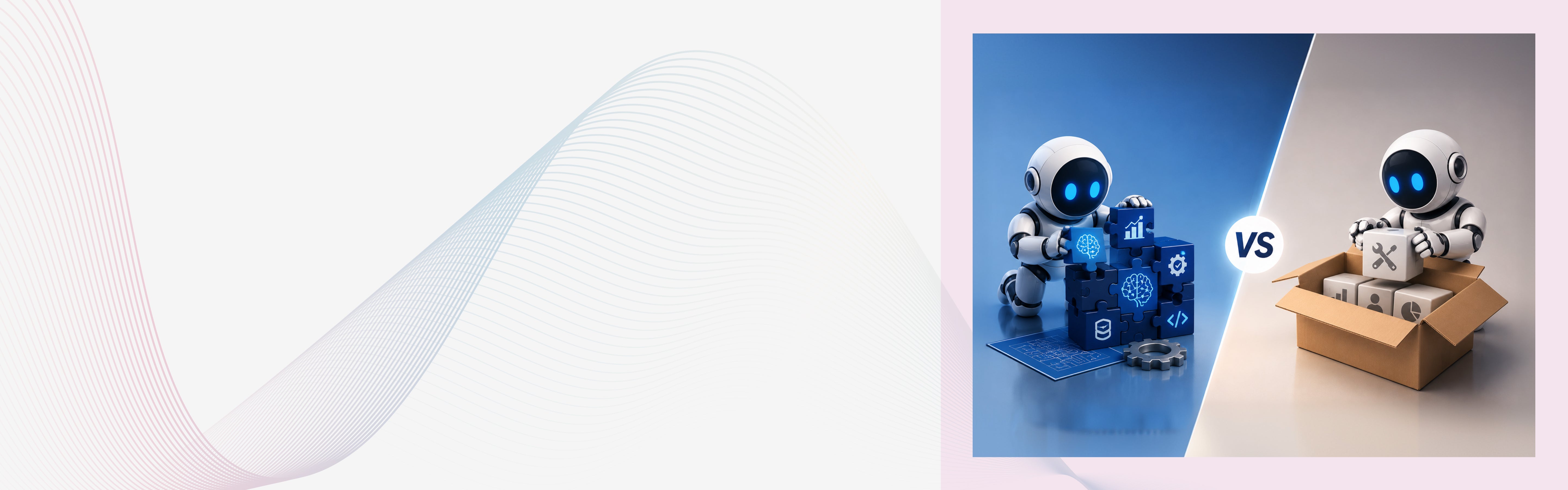
Every business reaching a certain stage of growth hits the same fork in the road: do you buy an AI tool that's ready to go today, or do you build something that actually fits how your business works?
It sounds like a technology question. But really, it's a business strategy question. And getting it wrong is expensive, either in wasted subscription costs, missed performance, or building something your team never actually uses.
According to McKinsey's 2025 State of AI report, 88% of organizations use AI in at least one business function, up from 78% the previous year. That's nearly universal adoption. But here's what the same research also shows: only 6% of organizations qualify as AI high performers, seeing significant enterprise-wide value, while the majority are adopting AI without transforming with it.
That gap between "using AI" and "getting value from AI" is often a direct result of choosing the wrong type of AI solution for the job.
So if you are also stuck on the road, this blog will help you make the right call when choosing between custom AI development and off-the-shelf tools.
What Exactly Are We Comparing?
Before diving into the decision factors, it's worth making sure we're talking about the same things.
Off-the-Shelf AI Tools
They are pre-built software products powered by AI. You subscribe, configure, and use them. Think tools like ChatGPT Enterprise, Microsoft Copilot, Salesforce Einstein, or a generic AI chatbot builder. The models are pre-trained, the interfaces are standardized, and the use cases are designed to serve thousands of businesses across many industries. The promise is speed: you can have something running in days.
Custom AI Development
It means building an AI system specifically around your business. Your data trains or fine-tunes the model. Your workflows define how the system behaves. Your compliance requirements shape the architecture. Whether it's a proprietary recommendation engine, a fine-tuned LLM for your internal knowledge base, a fraud detection model, or a computer vision system for quality control, custom-built AI is built to solve your problem, not a generalized version of it.
Both are valid paths. Neither is universally superior. The right answer depends on factors that are specific to your organization, your data maturity, and your long-term goals.
The Real State of AI Investment: Why This Decision Matters More Than Ever
Global AI spending is noted at $318 billion in Q4 2025, spending to Eclipse $1 trillion by 2029, according to IDC. Gartner confirms the momentum: AI and generative AI rank as the top two investment priorities for technology executives in 2026, with 91% of organizations increasing their GenAI budgets.
That's a lot of money in motion. And a significant portion of it is being allocated without a clear framework for choosing between build and buy.
An MIT analysis found that despite $30 to $40 billion in enterprise GenAI investment, 95% of organizations report no measurable financial return. Most projects stall at the pilot stage, not due to inadequate technology, but because of organizational challenges that off-the-shelf tools cannot address, including poor data readiness, misaligned workflows, and a persistent gap between C-suite expectations and what practitioners can realistically deliver.
Before you spend another dollar on AI, you need clarity on which path you're choosing and why. If you haven't thought through your organization's readiness yet, it is very important for businesses to perform an AI readiness assessment before investing in AI.
Off-the-Shelf AI Tools: Pros and Cons
What Makes Them Beneficial?
Speed to deployment
It is the biggest one. You're not building from scratch. Depending on the tool, you can be running in hours or days. For teams that need to demonstrate AI value quickly to leadership, this matters.
Lower upfront cost
Most off-the-shelf tools operate on subscription models. There's no large upfront development investment. For businesses testing AI use cases before committing, this reduces risk.
Vendor-managed maintenance
Updates, security patches, and model improvements happen on the vendor's side. You get improvements without doing the engineering work yourself.
Proven reliability
These tools have typically been tested across thousands of customers. The common failure modes are known. Documentation is thorough.
Where They Fall Short
While off-the-shelf tools are powerful, they are often disconnected from the actual work an enterprise does. They can write a poem, but they cannot query a company's legacy inventory database or automatically reconcile a complex invoice.
This is the core tension. The further your business's specific workflows deviate from what a tool was designed for, the less value you extract.
Limited customization
You work within the feature set the vendor built for a broad market. Niche workflows, domain-specific terminology, and complex multi-step processes rarely fit cleanly.
Data sovereignty concerns
With an off-the-shelf solution, you often must send your data to the vendor's cloud or use their managed service. That raises questions of data ownership, privacy, and compliance. You are entrusting sensitive business or customer data to a third party. For businesses in healthcare, finance, or any regulated industry, this is often a dealbreaker.
Vendor lock-in
Your AI capability is tied to one provider's roadmap, pricing decisions, and uptime. If the vendor raises prices, changes functionality, or gets acquired, your operations are at risk.
Cost at scale
Vendors often push enterprise tiers at $100K or more annually, and costs rise with license markups rather than actual infrastructure usage. What looks affordable in year one can become expensive by year three when you're running the tool across multiple teams.
Custom AI Development: Pros and Cons
Where Custom AI Wins
AI development for businesses is not about prestige. It's about fit. When your business problem is specific enough, or your data unique enough, building your own solution is the only way to unlock full value.
Performance on your actual data
Enterprise AI development achieves superior performance by leveraging organization-specific data patterns that generic solutions simply cannot recognize. Custom models can be trained on proprietary data that contains unique patterns relevant only to the specific organization. This is how you build systems that genuinely reflect your operations, not a generalized approximation.
Full data control and compliance
When you build your own AI system, your data stays where you put it. Compliance requirements, audit trails, encryption standards, and access controls can be baked in from day one rather than retrofitted as expensive add-ons.
Competitive differentiation
If your AI model is trained on your proprietary data, your competitors cannot replicate it by buying the same subscription. That becomes a durable advantage.
Scalable cost structure
Custom AI is cloud-native by design. Costs rise with infrastructure usage, not with license markups. You pay AWS or Azure bills, not penalties for success.
What Custom AI Demands From You
None of this is free. Custom AI development requires honesty about what your organization is ready to commit to.
Basic custom AI implementations start around $50,000, while enterprise-level systems range from $150,000 to $500,000 or more. Implementation spans 3 to 12 months for enterprise solutions. And annual maintenance typically costs 15 to 25% of the initial development investment.
Beyond budget, it requires organizational capacity. You need clean, accessible data. You need stakeholders who can articulate what the system should do. You need internal or external engineering talent who can build and maintain it. And you need patience, because the first version will not be the final version.
If these conditions aren't in place, the best custom AI team in the world won't save you.
Head-to-Head: Custom AI vs Off-the-Shelf Across What Actually Matters
| Decision Factor | Off-the-Shelf AI | Custom AI Development |
|---|---|---|
| Time to first use | Days to weeks | 3 to 12+ months |
| Upfront cost | Low (subscription) | High ($50K–$500K+) |
| Long-term cost | Scales with usage/tiers | Controlled after build |
| Data ownership | Vendor-managed | Fully yours |
| Customization depth | Limited to vendor features | Unlimited |
| Integration flexibility | API/plugin based | Built to your stack |
| Compliance control | Vendor-defined | Architecture-level control |
| Competitive moat | Shared with competitors | Proprietary |
| Maintenance burden | Vendor handles | Internal / partner |
| Scalability | Vendor-dependent | Cloud-native, on your terms |
The ROI Question: Which One Actually Pays Off?
This is where a lot of conversations oversimplify. Off-the-shelf tools look cheaper on a spreadsheet in year one. Custom AI development looks expensive. But extend the horizon and the picture changes.
Companies using generative AI achieve an average ROI of $3.70 for every dollar spent. But averages mask the real story. AI high performers attribute over 10% of their EBIT to successful AI deployment and achieve returns exceeding $10.30 per dollar invested, nearly three times the average.
That top-performing group is not running off-the-shelf tools at scale. They've invested in custom systems built around their specific workflows.
The return on custom AI development is rarely linear. It's often back-loaded, meaning you invest heavily upfront, see modest returns in the first year, and then compound value as the system improves with more data and more usage.
When to Choose Off-the-Shelf AI Tools?
Off-the-shelf is the right answer in specific, well-defined situations. It is not a compromise; it is genuinely the best choice when:
Your use case is standard
Content generation, generic customer support chatbots, meeting transcription, basic sentiment analysis these are solved problems. A pre-built tool does them well, and building custom adds no value.
You need to move fast
If you're piloting AI to validate a business case internally, speed matters more than optimization. Start with a tool, prove the concept, then consider building if the ROI case holds.
Your team lacks AI engineering depth
Custom AI development without the right internal or external team is how you end up with expensive, broken experiments. If you don't have access to solid AI development services, off-the-shelf tools with a qualified implementation partner are often more realistic.
Budget is genuinely constrained
Early-stage companies and small teams often cannot absorb a six-figure AI development project. For them, off-the-shelf tools with smart configuration can deliver real value until they're ready to build.
The problem doesn't need proprietary data
If generic training data is sufficient for your use case, there's no reason to invest in custom model development.
When to Choose Custom AI Development?
The signal for custom AI is clearer than most people think. It's not about ambition; it's about specificity.
Your data is your advantage
If your business has accumulated years of proprietary operational data, customer behavior data, or domain-specific knowledge that competitors don't have, a custom model trained on that data can create something no off-the-shelf tool can replicate. This is where AI development services translate raw data into lasting competitive advantage.
Your workflows are non-standard
The more your processes deviate from generic industry patterns, the less off-the-shelf tools will fit. If you've found yourself trying to bend your operations to fit the tool rather than the other way around, that's the signal.
Compliance is non-negotiable
Healthcare, finance, legal, and government sectors often have data residency, privacy, and auditability requirements that cannot be met by sending data to a vendor's cloud. Custom AI development lets you design compliance in from day one.
Integrating into legacy systems
Custom solutions are designed to integrate with existing enterprise systems and legacy infrastructure from the outset, eliminating the need for later workarounds. This creates a unified intelligence layer across all operational channels, ensuring consistent application of insights and automation throughout the business.
Scaling to multiple teams or divisions
Once AI is running across a large organization, the licensing costs of off-the-shelf tools grow fast. Custom AI on cloud infrastructure often becomes cheaper per unit at scale.
You want to own the roadmap
With a vendor product, you're at their mercy for new features, pricing changes, and deprecations. With a custom system, your team decides what gets built next and when.
The Hybrid Path: A Practical Middle Ground
Many enterprises don't have to make a binary choice. A hybrid approach often makes more sense, especially for organizations that are past the experimentation phase but not yet ready to go fully custom.
The pattern typically looks like this:
Start with off-the-shelf tools for standard, non-strategic use cases. Use them for content drafting, meeting notes, generic support automation, and anything where generic performance is sufficient. These buy your team time and demonstrate quick wins to leadership.
In parallel, invest in custom AI development for your highest-value, most differentiated use cases. This is where your proprietary data lives, where compliance matters most, and where the ROI case is clearest.
Over time, the mix shifts as custom systems prove out and the limitations of off-the-shelf tools become more visible at scale.
H&M is a well-documented example. The company began with generic AI chatbots to answer customer questions but eventually invested in its own enterprise AI platform to gain flexibility and control. This shift illustrates how businesses often outgrow the boundaries of standard tools and move toward tailored AI applications.
Custom AI Solutions vs Off-the-Shelf Tools: Decision Framework
Most organizations overthink this. Here is a straightforward way to work through it.
Step 1: Define the problem precisely
"Use AI" is not a problem. "Reduce time to process insurance claims from 5 days to same-day" is a problem. The more specific you can be, the clearer the right path becomes.
Step 2: Audit your data
Custom AI only works if you have data worth training on. Before considering custom development, assess what data you have, how clean it is, and whether it's actually representative of the problem you're solving. If your data is fragmented or unreliable, no model will save you.
Step 3: Map your compliance requirements
Do a quick audit of what data residency, privacy, and auditability requirements apply to your use case. If the answer is "significant," off-the-shelf tools with vendor-managed cloud processing may already be off the table.
Step 4: Calculate the true cost of both paths over three years
Don't compare year-one subscription cost to year-one development cost. Build out a three-year model. Include licensing growth, maintenance, and the cost of workarounds you'll build when the off-the-shelf tool doesn't quite fit.
Step 5: Assess your team's capacity
Custom AI development requires ongoing collaboration from your side, not just from the development partner. Do you have the internal stakeholders, data access, and project management bandwidth to support a multi-month build?
Step 6: Start with a pilot, not a platform
Whether you go custom or off-the-shelf, don't buy or build a complete platform before validating a specific use case. Run a focused proof of concept first. Expand based on what actually works.
If steps 1 through 5 leave you uncertain about whether your organization is AI-ready, working with a qualified AI consulting firm to assess your current state is money well spent before committing to any technology path. That foundational work tends to prevent the expensive mistakes that come from skipping it.
Industry-Specific Considerations
Healthcare and life sciences
Data privacy regulations, HIPAA compliance, and the criticality of accuracy in clinical applications almost always push toward custom AI. The risk of sending patient data to a generic vendor's cloud is rarely acceptable.
Financial services
Fraud detection, underwriting automation, and risk modeling benefit enormously from models trained on proprietary transaction data. Off-the-shelf tools rarely have the domain specificity or data privacy guarantees that regulated financial institutions require.
Retail and e-commerce
Standard use cases like product recommendations and customer support chatbots are well served by off-the-shelf tools. But once you get into demand forecasting on proprietary inventory data or hyper-personalization at scale, custom development starts to pay off.
Manufacturing
Quality control, predictive maintenance, and supply chain optimization are areas where the patterns are highly specific to each facility, equipment set, and production process. Custom AI trained on your sensor data consistently outperforms generic tools here.
Professional services
For law firms, consultancies, and agencies, the opportunity is in building systems that run on proprietary knowledge and documents. LLMs fine-tuned on internal knowledge bases can transform how teams access and apply institutional knowledge in ways no generic tool matches.
What "Choosing Right" Actually Looks Like?
There is no universal answer here. The companies that get this right don't start with a technology preference; they start with a clear understanding of what they're trying to accomplish and an honest assessment of what they have to work with.
They also don't treat this as a permanent decision. The choice between custom AI and off-the-shelf tools is not static. As your organization builds AI literacy, cleans its data, and develops engineering capacity, the calculus shifts. Many companies that started on off-the-shelf tools have graduated to custom development as they scaled. That's not a detour; that's a sequence that works.
What doesn't work is picking a path because it looks good in a vendor demo, or because a competitor is doing it, or because leadership wants a number to put in the next board presentation.
The framework above clarifies the problem, audits the data, maps compliance, models costs over three years, assesses team capacity, and pilot before you platform is not complicated. But it takes discipline to follow it when there's pressure to move fast.
If you're working through this decision and want a structured view of what's involved in getting AI into production, this practical guide on implementing AI in your business covers the implementation side in detail.
Conclusion
The question of custom AI development versus off-the-shelf AI tools is not a technical question. It is a strategic one. And it doesn't have a single right answer; it has the right answer for your business, given your data, compliance requirements, competitive position, and your team's capacity to execute.
Off-the-shelf tools are real solutions for real problems. They are not stepping stones for organizations too unsophisticated to build custom AI. They are the correct answer for a specific class of use cases: standard workflows, fast time-to-value requirements, and situations where generic model performance is sufficient.
Custom AI development is not about complexity for its own sake, either. It earns its investment when your business problem is specific, your data is proprietary, your compliance requirements are strict, and you're ready to build something that compounds in value over time.
Most mature enterprises will use both. The skill is in knowing which problem belongs in which bucket. Start with the problem. Let the problem dictate the path.
Ready to explore what custom AI solutions work for your business? Connect with us today. Lucent Innovation specializes in custom AI development services for businesses that have outgrown generic tools and are ready to build AI that actually fits their operations. Whether you're starting from scratch or extending existing AI investments, our team brings the technical depth and strategic thinking to get it right.


