

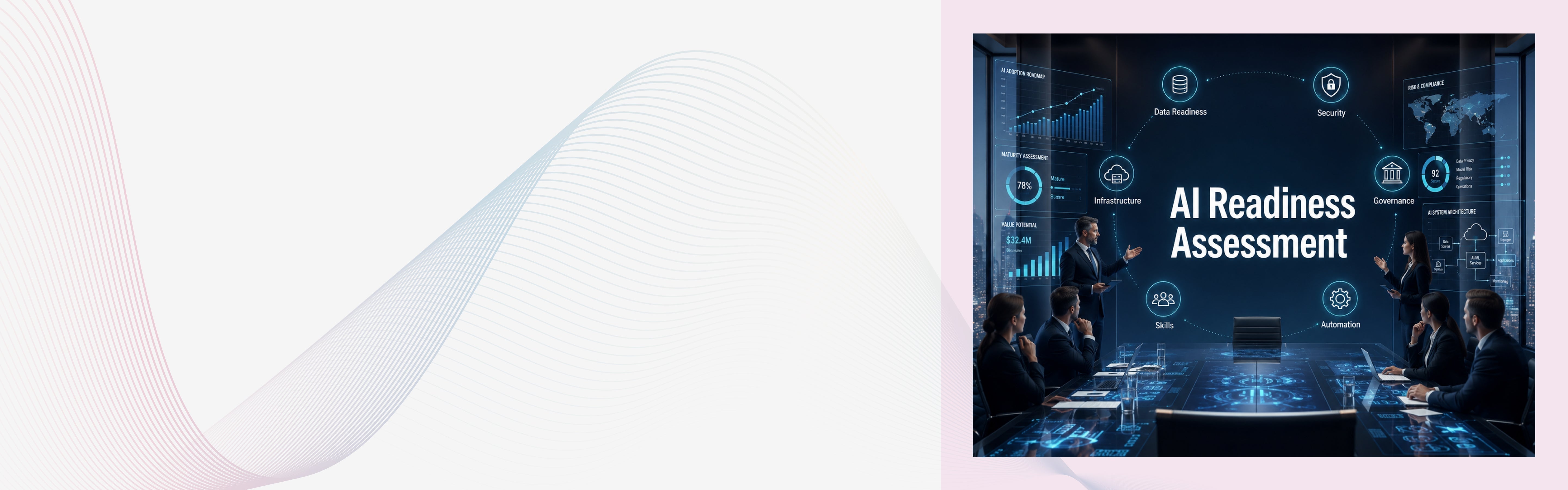
AI is becoming a major priority for enterprises, but investing in AI without preparation can lead to wasted budgets, failed pilots, security risks, and poor adoption. Before choosing tools, platforms, or vendors, businesses need to understand whether they are truly ready.
That is where an AI readiness assessment becomes important.
It gives enterprises a clear view of their current capabilities, gaps, risks, and opportunities before they invest in artificial intelligence. With the right AI readiness checklist, leaders can make better decisions and create a practical roadmap for AI success.
What Is an AI Readiness Assessment?
An AI readiness assessment is a structured evaluation of an organization’s ability to adopt and scale AI effectively.
It reviews key areas such as:
- Business goals
- Data quality
- Technology infrastructure
- Security and compliance
- Internal skills
- Governance
- Process maturity
- ROI expectations
The purpose is simple: to find out whether your enterprise is ready for AI, where AI can create value, and what needs to be fixed before implementation.
Why Enterprises Need an AI Readiness Assessment
AI is not just another software investment. It affects data, people, workflows, customer experience, decision-making, and risk management.
A proper AI readiness assessment helps enterprises:
- Identify high-value AI use cases
- Avoid investing in the wrong tools
- Understand data and infrastructure gaps
- Reduce security and compliance risks
- Build leadership alignment
- Estimate ROI before implementation
- Create a realistic AI roadmap
Without this step, businesses may launch AI pilots that look promising but fail to scale.
Enterprise AI Readiness Checklist
Here is a practical AI readiness checklist to review before investing in AI.
1. Business Strategy Readiness
AI should start with a clear business problem, not with a tool.
Ask:
- What problem are we solving with AI?
- How does this support business goals?
- Which teams will benefit most?
- What outcome do we want to measure?
- Do executives agree on AI priorities?
Good AI use cases are connected to measurable goals such as reducing costs, improving customer experience, increasing revenue, saving time, or improving decision-making.
2. Use Case Readiness
Not every process is ready for AI. Enterprises should choose use cases based on value, feasibility, risk, and available data.
Strong starting points include:
- Customer support chatbots
- Intelligent document processing
- Sales forecasting
- Product recommendations
- Internal knowledge assistants
- Marketing automation
- Automated reporting
- AI-powered workflow automation
A strong AI readiness assessment helps prioritize use cases that can deliver quick and measurable impact.
3. Data Readiness
AI depends on reliable data. If your data is incomplete, outdated, scattered, or poorly managed, AI results may be inaccurate.
Review:
- Is our data clean and accessible?
- Do we know where key data lives?
- Who owns each data source?
- Can systems share data securely?
- Are privacy and compliance requirements clear?
Data readiness is one of the most important parts of any AI readiness checklist.
4. Technology Readiness
Enterprises need the right technical foundation to support AI. This includes cloud infrastructure, APIs, integrations, security systems, and monitoring tools.
Ask:
- Can our current systems support AI?
- Do we need cloud or application modernization?
- Are our systems integrated?
- Can AI tools access data securely?
- Do we have monitoring and deployment processes?
The goal is not always to build everything from scratch. It is to make sure AI can work smoothly with your existing business systems.
5. Governance, Security, and Compliance Readiness
AI must be used responsibly. Enterprises need clear rules for data usage, approvals, security, human review, and risk management.
Your AI readiness checklist should include:
- AI usage policies
- Data privacy controls
- Access permissions
- Human approval for sensitive decisions
- Bias and accuracy checks
- Vendor security reviews
- Compliance requirements
- Audit trails
NIST’s AI Risk Management Framework highlights the importance of trustworthy AI characteristics such as reliability, safety, security, transparency, accountability, privacy, and fairness.
6. Talent and Skills Readiness
AI success also depends on people. Enterprises need technical experts, business leaders, and trained users who understand how to work with AI.
Evaluate whether you have:
- AI strategy expertise
- Data engineering skills
- Cloud and integration skills
- Security and compliance support
- Business process knowledge
- Employee AI training
Employees should know when to trust AI, when to review outputs, and how to use AI tools responsibly.
7. Process Readiness
AI works best when business processes are clear and repeatable. If workflows are confusing or inconsistent, AI may only automate existing problems.
Ask:
- Are key workflows documented?
- Are approval steps clear?
- Are repetitive tasks identified?
- Can the process be improved before automation?
- Are performance metrics available?
Before applying AI, enterprises should simplify and standardize processes wherever possible.
8. ROI Readiness
AI investment should be tied to business value. Before starting, define what success looks like.
Common ROI metrics include:
- Cost savings
- Time saved
- Revenue growth
- Fewer manual errors
- Faster customer response
- Better forecasting accuracy
- Higher productivity
- Improved customer satisfaction
An AI readiness assessment helps enterprises estimate costs, risks, benefits, and expected returns before committing to full-scale AI investment.
How Lucent Innovation Helps Enterprises Become AI-Ready?
Lucent Innovation helps businesses move from AI interest to AI execution with a practical, enterprise-first approach.
The team supports companies with:
- AI readiness assessment consulting
- AI strategy and roadmap planning
- Custom AI solution development
- Generative AI integration
- AI chatbot and assistant development
- Data engineering and analytics
- Ecommerce AI solutions
- Cloud-based AI implementation
- AI-powered automation
- Ongoing support and optimization
Lucent Innovation is your one-stop partner for AI consulting services to build a solution that is useful, scalable, secure, and aligned with real business goals. Whether your enterprise is exploring AI for the first time or looking to scale existing pilots, Lucent Innovation can help create a clear path forward.
Final Thoughts
AI can deliver major value, but only when enterprises are ready to use it strategically. A structured AI readiness assessment helps businesses understand their current maturity, identify gaps, and choose the right AI opportunities.
Before investing in AI, use a practical AI readiness checklist to evaluate strategy, data, infrastructure, governance, security, talent, processes, and ROI.
With the right preparation and the right technology partner, enterprises can turn AI from an experiment into a measurable business advantage. Lucent Innovation can help you assess, plan, and build AI solutions that support long-term growth. Let's connect today.


