

Imagine your company has two storage rooms.
The first one is a library. Everything is organized on labeled shelves. You can find anything in seconds. But to put something new in, a librarian has to sort and catalog it first. Raw, messy stuff cannot go in. Only clean, formatted items are allowed.
The second one is a giant garage. You can throw anything in there. Raw materials, old equipment, unusual items that do not fit standard shelves. It costs almost nothing to store things. But finding what you need takes forever, because nothing is labeled or organized.
For years, data teams lived with both. The library was the data warehouse. The garage was the data lake. Every time a data scientist needed raw material and an analyst needed a clean report, they worked from different places, different copies and often got different answers.
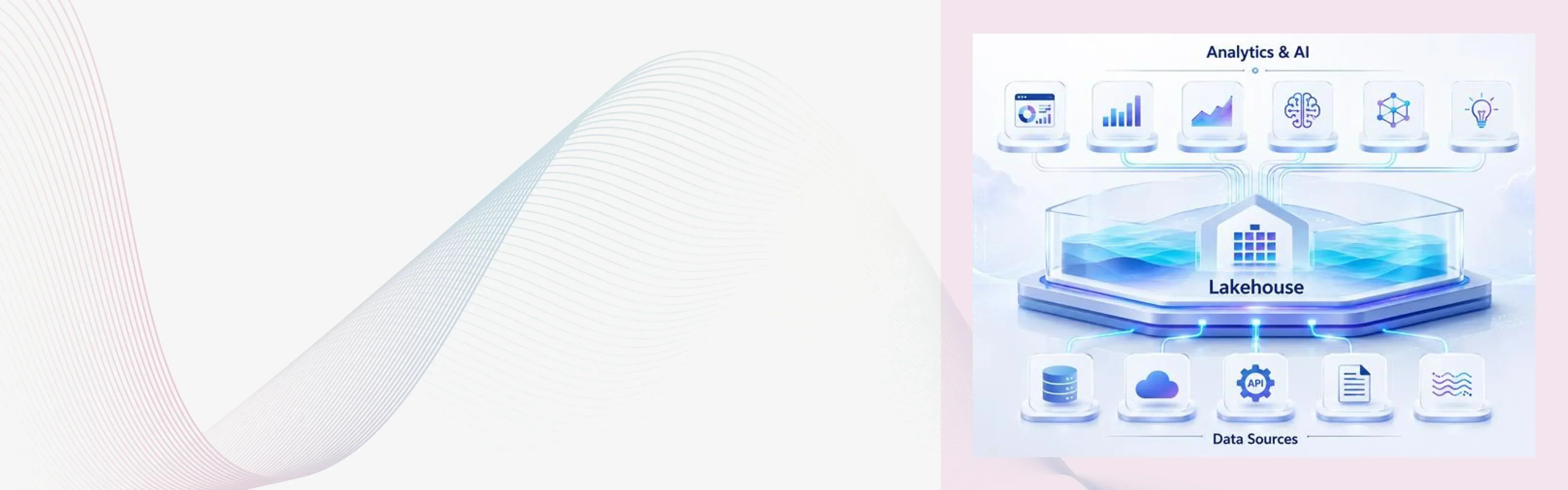
Lakehouse architecture is what you get when you combine them into one room. You keep the cheap, flexible storage of the garage. Then you add the organization, labels, and reliability rules of the library on top. Same room. Same data. Works for everyone.
That is the core idea behind lakehouse architecture. And if you want to understand the full history of why data teams needed this solution, Data Warehouse vs Data Lake vs Lakehouse covers exactly how the two-system problem developed and why the lakehouse won.
For the complete series context, Modern Data Engineering: The Complete Guide is the right starting point.
Where Lakehouse Architecture Came From
The term "lakehouse" did not appear overnight. It emerged from a real problem that thousands of data teams were experiencing at the same time.
By the early 2010s, most enterprise data teams ran two systems side by side. A data lake on cloud object storage held raw, flexible data for machine learning and exploration. A separate data warehouse held clean, structured data for business intelligence and reporting. Every night, pipelines moved data from the lake into the warehouse. Engineers maintained both. Costs doubled. Pipelines drifted out of sync. The same question often got two different answers depending on which system someone queried.
As Xebia's March 2026 lakehouse architecture explainer documents, the term was first sketched informally in 2017 at a Big Data meetup. The vision was finally formalized in a 2021 research paper titled "Lakehouse: A New Generation of Open Platforms that Unify Data Warehousing and Advanced Analytics," co-authored by researchers from UC Berkeley and engineers from Databricks. That paper turned a vague concept into a concrete architectural blueprint with eight specific technical requirements a lakehouse must satisfy.
Databricks' original lakehouse blog post described the insight clearly: a lakehouse is what you would get if you had to redesign data warehouses in the modern world, now that cheap and highly reliable storage in the form of object stores is available. The idea was not to replace cloud storage with something proprietary. It was to add database-quality management directly on top of the open files already sitting in object storage.
In 2026, the architecture has matured from experimental to mainstream. According to Promethium's March 2026 enterprise lakehouse guide, lakehouse architecture has become the dominant pattern for modern enterprise analytics, with clear patterns, proven performance, and comprehensive tooling at each layer.
The 4 Core Layers of Lakehouse Architecture
Every lakehouse is built from the same four layers. Each layer has a specific job. Remove any one of them and the architecture breaks.
Layer 1: The Storage Layer: Where All Data Lives
The foundation of every lakehouse is cloud object storage. Amazon S3, Azure Data Lake Storage, and Google Cloud Storage are the three dominant options. Data sits here as files in open formats, primarily Apache Parquet and ORC.
Object storage is what makes the lakehouse economics work. As Promethium's enterprise guide notes, this architecture typically costs $30 to $50 per terabyte annually compared to $500 to $2,000 for traditional warehouses with bundled compute and storage. That is a 10 to 40 times cost difference for the storage layer alone.
The storage layer holds everything: structured tables, semi-structured JSON, raw logs, images, model artifacts, and streaming event files. No schema is required before data lands. This is what gives the lakehouse the flexibility of the original data lake model.
Crucially, the storage layer is compute-independent. The same S3 bucket or Azure Data Lake Storage container can be read by Apache Spark, Trino, DuckDB, or any other engine that supports the open formats. You are not locked into a single vendor's compute engine because the storage is open.
Layer 2: The Open Table Format Layer: Where ACID Transactions Live
This is the layer that separates a lakehouse from a plain data lake. And it is the single most important technical innovation that made lakehouse architecture viable for production workloads.
An open table format sits on top of the raw files in object storage and turns a folder of Parquet files into a managed table with database-quality guarantees.
As ClickHouse's lakehouse architecture breakdown explains, the table format tracks which files belong to which table, which snapshot of the table is current, and what the schema looks like. This is what gives the lakehouse ACID transactions, schema evolution, time travel, and reliable concurrent writes. Without a table format layer, you just have files.
The three dominant open table formats in 2026 are:
| Table Format | Origin | Key Strength | Best Known Use |
|---|---|---|---|
| Delta Lake | Created at Databricks, open-sourced under Linux Foundation | Tight Spark integration, native Databricks support, Change Data Feed | Databricks lakehouse, default on Azure |
| Apache Iceberg | Created at Netflix, donated to Apache | Most engine-neutral, hidden partitioning, full hyperscaler support | Multi-engine architectures, AWS/GCP native |
| Apache Hudi | Created at Uber, donated to Apache | Optimized for record-level upserts and CDC at scale | Streaming upsert-heavy workloads |
As Xebia documents, emerging single-node engines like DuckDB added full Iceberg read and write capabilities in 2025. Polars integrates via PyIceberg. The table format layer is now readable by virtually every major data processing engine.
Delta Lake Explained for Data Engineers covers how Delta Lake specifically implements ACID guarantees through a transaction log, how time travel lets you query any historical snapshot of your data, and how Change Data Feed tracks row-level changes for CDC pipelines.
Layer 3: The Metadata and Catalog Layer: Where Governance Lives
The metadata layer is where the lakehouse becomes governable, discoverable and auditable.
Plain object storage has no concept of who owns a dataset, what its columns mean, who is allowed to read it, or where it came from. The metadata layer adds all of that. It is the difference between a storage system and a governed data platform.
As OvalEdge's lake vs lakehouse guide explains, lakehouse-native catalogs like Databricks Unity Catalog or Apache Iceberg's built-in metadata layers store schema, statistics and lineage information directly with the table. This allows users to query metadata as easily as querying the data itself. Unlike traditional catalogs that sit adjacent to storage as documentation tools, the metadata layer in a lakehouse is operational infrastructure.
What a well-implemented metadata layer provides:
- Schema management: Every table has a defined, enforced schema. New columns are added through controlled schema evolution, not silent drift.
- Data lineage: You can trace exactly where any piece of data came from, which pipeline produced it and which downstream tables depend on it.
- Access control: Column-level, row-level, and table-level permissions are enforced at the catalog layer before compute engines even read the data.
- Data discovery: Engineers and analysts can find datasets, understand their business meaning, and assess their quality without asking the person who built the pipeline.
- Audit logging: Every read and write is recorded. Compliance teams can see exactly who accessed what data and when.
According to Promethium's 2026 enterprise guide, well-designed metadata systems reduce query planning time by 30 to 50% through cached statistics and optimized lookups. The metadata layer is not just governance overhead. It actively makes queries faster.
In 2026, a major shift has occurred in this layer. As Xebia reports, the mid-2024 open-sourcing of Databricks' Unity Catalog and the broad adoption of the Iceberg REST Catalog specification enabled multi-engine governance for the first time. Previously, each compute engine had its own catalog. Now, a single REST Catalog like Apache Polaris or open-source Unity Catalog can govern tables across Spark, Trino, DuckDB, and Flink simultaneously.
Layer 4: The Compute and Serving Layer: Where Queries Run
The top layer is where data actually gets used. The compute layer is completely decoupled from storage, which means you can scale processing power up or down independently without touching the data.
As the Databricks well-architected lakehouse documentation explains, the Databricks lakehouse uses Apache Spark and the Photon engine for all transformations and queries. SQL warehouses handle SQL queries and BI workloads. Workspace clusters handle Python, Scala, and machine learning workloads. Both read from the same Delta Lake tables in object storage.
Different compute engines serve different workload types in a mature lakehouse:
| Workload Type | Compute Engine | Characteristics |
|---|---|---|
| Large-scale batch ETL | Apache Spark | Distributed, handles petabytes, best for complex joins |
| Interactive SQL analytics | Databricks SQL with Photon | Fast, columnar, optimized for BI patterns |
| Streaming ingestion | Structured Streaming | Continuous micro-batch or real-time mode |
| Machine learning | Spark MLlib, MLflow, GPU clusters | Feature engineering, model training, tracking |
| Lightweight analytics | DuckDB, Trino, Polars | Fast, single-node or small-cluster, low overhead |
The key architecture principle at this layer is that multiple different compute engines can read the same data simultaneously without conflicts. A Spark pipeline can write to a Delta table while Databricks SQL queries the same table in another session. The ACID guarantees in the table format layer handle concurrency automatically.
How Lakehouse Architecture Solves the Two-System Problem
The two-system problem is the most expensive consequence of running a data lake and a data warehouse in parallel. Understanding exactly how the lakehouse solves it makes the architecture decision concrete.
Problem 1: Data Duplication
In a two-system architecture, data lives in the lake in raw form and then gets copied into the warehouse in structured form. Two copies of the same data means two storage bills, two pipelines to maintain, and two places where things can go wrong.
The lakehouse eliminates this because both analytics (SQL warehouse workloads) and data science (raw exploration and model training) read from the same storage layer. No copying. As Microsoft's Azure Databricks documentation confirms, a lakehouse can help establish a single source of truth, eliminate redundant costs, and ensure data freshness across all workloads.
Problem 2: Sync Failures and Inconsistent Metrics
When data moves from a lake to a warehouse on a pipeline schedule, the two systems can fall out of sync. An analyst querying the warehouse and a data scientist querying the lake see different numbers for the same question. This is one of the most trust-destroying problems in data organizations.
The lakehouse fixes this by definition. There is one copy of the data. One pipeline writes to it. Everyone reads from the same version. No sync required. No drift possible.
Problem 3: Schema Drift on Raw Data Lakes
In a plain data lake, source systems can change their output format and nobody notices until a downstream query breaks. The lakehouse enforces schema at the table format layer. Writes that do not match the defined schema are rejected immediately. When schemas do need to change, they are changed explicitly through controlled evolution, not silently absorbed.
Problem 4: No Governance on Raw Files
Raw files in object storage have no native access control below the bucket or folder level. The lakehouse adds column-level security, row-level filtering, and table-level permissions through the metadata catalog layer. A data engineer can grant an analyst read access to specific columns in a table without exposing the entire dataset or raw file structure.
The 7 Technical Requirements Every Lakehouse Must Meet
The original 2021 UC Berkeley and Databricks research paper defined eight specific requirements for a system to qualify as a lakehouse. In 2026, these remain the benchmark. Here are the seven that matter most in practice:
- ACID Transactions: Every write is atomic. Partial writes do not exist. Concurrent reads and writes do not corrupt data.
- Schema Enforcement and Evolution: Incoming data must match the defined schema or be rejected. When schemas legitimately change, the evolution is controlled and tracked.
- BI Support: The lakehouse must support SQL querying with performance competitive with dedicated warehouses. Analysts should not feel penalized compared to a traditional warehouse.
- Decoupled Storage and Compute: Storage and compute scale independently. You pay only for the compute you use, not a permanent allocation tied to storage size.
- Openness: Data is stored in open file formats. Multiple engines can read it. No vendor lock-in on the storage layer.
- Support for Diverse Workloads: One system handles batch ETL, SQL analytics, streaming ingestion, machine learning, and AI inference workloads from the same data.
- End-to-End Streaming: The lakehouse processes streaming data natively, not as a bolt-on afterthought. Streaming tables land data with exactly-once guarantees into the same Delta or Iceberg tables that batch queries read.
As DEV Community's 2025-2026 lakehouse ecosystem guide notes, by 2025 this model matured from a promise into a proven architecture. Streaming-first ingestion, autonomous optimization, and catalog-driven governance have become baseline requirements, not differentiators.
How Databricks Implements Lakehouse Architecture
Databricks built the lakehouse architecture and remains the leading platform for implementing it in production.
The Databricks implementation maps every lakehouse layer to a specific set of tools:
- Storage layer: Cloud object storage (S3, Azure Data Lake Storage, GCS) with data stored in open-format Parquet files
- Table format layer: Delta Lake, handling ACID transactions, schema enforcement, time travel, and Change Data Feed
- Metadata and catalog layer: Unity Catalog, providing governance, lineage, access control, and data discovery across all workspaces and workload types
- Compute and serving layer: Apache Spark (general processing), Photon engine (vectorized SQL acceleration), Databricks SQL (warehousing workloads), and serverless compute for on-demand scaling
As Microsoft's Azure Databricks reference architecture documentation (last updated March 2026) describes, the lakehouse uses Lakeflow Connect for ingestion, Lakeflow Spark Declarative Pipelines for transformation, and Lakeflow Jobs for orchestration. Unity Catalog is the central governance layer that governs all of these: tables, volumes, features in the feature store, and models in the model registry.
The well-architected lakehouse on Databricks is organized around seven pillars: operational excellence, security and compliance, reliability, performance efficiency, cost optimization, governance, and interoperability. The last two are Databricks-specific additions to the standard AWS Well-Architected Framework pillars, reflecting the unique governance and multi-engine integration requirements of the lakehouse.
How Medallion Architecture Organizes Data Inside the Lakehouse
The lakehouse does not just define how data is stored. It defines how data flows through progressive refinement layers before it reaches analysts and ML engineers.
The Medallion Architecture pattern organizes this flow into three tiers:
- Bronze layer: Raw data lands from source systems exactly as ingested. No transformations. No filtering. A permanent, replayable record of what arrived.
- Silver layer: Cleaned, validated, and deduplicated data. Schema enforced. CDC changes applied. Quality checks passed. Ready for analytical use.
- Gold layer: Aggregated, business-ready tables. Optimized for specific reporting, dashboard, or ML feature store use cases.
Medallion Architecture in Databricks covers how to design, build, and operate each tier in practice, including how Lakeflow Spark Declarative Pipelines manages data flow between tiers automatically and how data quality expectations are enforced at the Silver and Gold layers.
For the complete implementation picture, including how all Databricks components fit together from ingestion through governance, Databricks for Data Engineering: Architecture, Components, and Best Practices****is the full technical reference.
Lakehouse Architecture in 2026: What Is New
Lakehouse architecture has not stood still. Several meaningful changes have happened since the original concept was formalized in 2021.
The Real-Time Layer Has Become a Baseline Requirement
The original lakehouse was fundamentally a batch system. Data arrived in hourly or daily loads. Real-time questions could not be answered from it.
As Medium's April 2026 real-time lakehouse analysis explains, the data lakehouse architecture in 2026 is not a single product. It is a set of interoperating open components: a streaming SQL engine for the hot tier, an open table format for the warm and cold tiers, query engines for analytical access, and a REST Catalog for governance. The hot, warm, and cold tier model separates the freshest streaming data from historical analytical data while keeping both governed under the same catalog.
On Databricks, this is implemented through Structured Streaming with Real-Time Mode (RTM), which reached general availability in March 2026 and achieves P99 latency in the single-digit milliseconds range for streaming workloads landing directly into Delta tables.
Apache Iceberg Is Now the Multi-Engine Standard
When the lakehouse concept was formalized, Delta Lake was the primary table format on Databricks and other warehouses were building proprietary alternatives. In 2026, Apache Iceberg has emerged as the cross-platform standard that every major cloud provider and data platform has committed to support.
As DEV Community's lakehouse ecosystem guide notes, with formats like Apache Iceberg, Delta Lake, Hudi, and Paimon, data teams now have open standards for transactional data at scale. This multi-format reality means engineering teams can choose the format that best suits their multi-engine requirements without being locked into a single vendor's compute stack.
Federated Catalogs Enable Lakehouses Without Data Centralization
A major 2026 innovation is the federated catalog pattern. Rather than requiring all data to be moved into a single centralized storage location, federated catalogs like Apache Polaris enable unified metadata management across multiple storage locations and cloud providers.
As Promethium's 2026 enterprise guide documents, a financial services firm with 150 users achieved 40% faster queries after consolidating seven legacy warehouses into a centralized lakehouse. But data consolidation required eight months. For organizations with data residency constraints, multi-cloud operations, or legacy systems that resist consolidation, federated architectures deliver lakehouse governance benefits without requiring data movement.
How to Know If You Need Lakehouse Architecture
Lakehouse architecture is the right choice for most teams building or rebuilding a data platform in 2026. But "most" is not "all." Here is a practical framework.
You need a lakehouse if:
You have both analytics and data science workloads drawing from the same data and you are tired of maintaining two separate systems for them. You are storing unstructured or semi-structured data that a traditional warehouse cannot handle. You want to eliminate data duplication and the sync failures that come with a two-system architecture. You are building AI or machine learning workloads and need raw, governed, accessible data in one place. You want to avoid proprietary storage formats and keep your options open across compute engines.
A traditional warehouse may still serve you if:
Your entire workload is structured SQL analytics with no machine learning or unstructured data requirements. Your existing warehouse investment is mature, performing well, and migration cost outweighs the benefit. Your team is small and the operational complexity of a full lakehouse exceeds your capacity.
What Is Databricks and Why Data Teams Use It covers how the Databricks platform makes the lakehouse practical for real engineering teams, including the serverless compute options that reduce operational overhead significantly compared to self-managed Spark clusters.
What Comes Next in This Series
This article covered what lakehouse architecture is, how its four layers work, and how Databricks implements it. The next articles in this series go deeper on every component introduced here.
- The storage foundation: Delta Lake Explained for Data Engineers covers ACID transactions, schema enforcement, time travel, and Change Data Feed in technical detail.
- Data organization inside the lakehouse: Medallion Architecture in Databricks covers how Bronze, Silver, and Gold layers are designed, built, and operated.
- The full platform: Databricks for Data Engineering: Architecture, Components, and Best Practices covers every component of the Databricks stack and how they fit together.
- Where the lakehouse came from: Data Warehouse vs Data Lake vs Lakehouse covers the full history and comparison of all three storage architectures.
Wrapping Up: Why the Lakehouse Architecture Matters
Think back to the garage and the library analogy from the beginning of this article.
Data teams spent years making a choice they should not have had to make. Use the warehouse and get reliability but lose flexibility. Use the lake and get flexibility but lose reliability. Either way, someone on the team was frustrated, working around the system, or paying for things that should not have been necessary.
The lakehouse took that choice away. You store everything once. You get reliability, governance, and performance on top of it. Your analysts get fast, clean answers. Your data scientists get raw, accessible data. Your ML engineers get a governed feature store. Your compliance team gets lineage and audit trails.
That is not just a technical improvement. It is a simpler way to work with data. Fewer systems to manage. Fewer copies to reconcile. Fewer fires to fight when pipelines drift out of sync.
In 2026, the lakehouse is not a bet on a new technology. It is the baseline architecture that most serious data teams are already running. The question is no longer whether to adopt it. It is how to build it well.

