

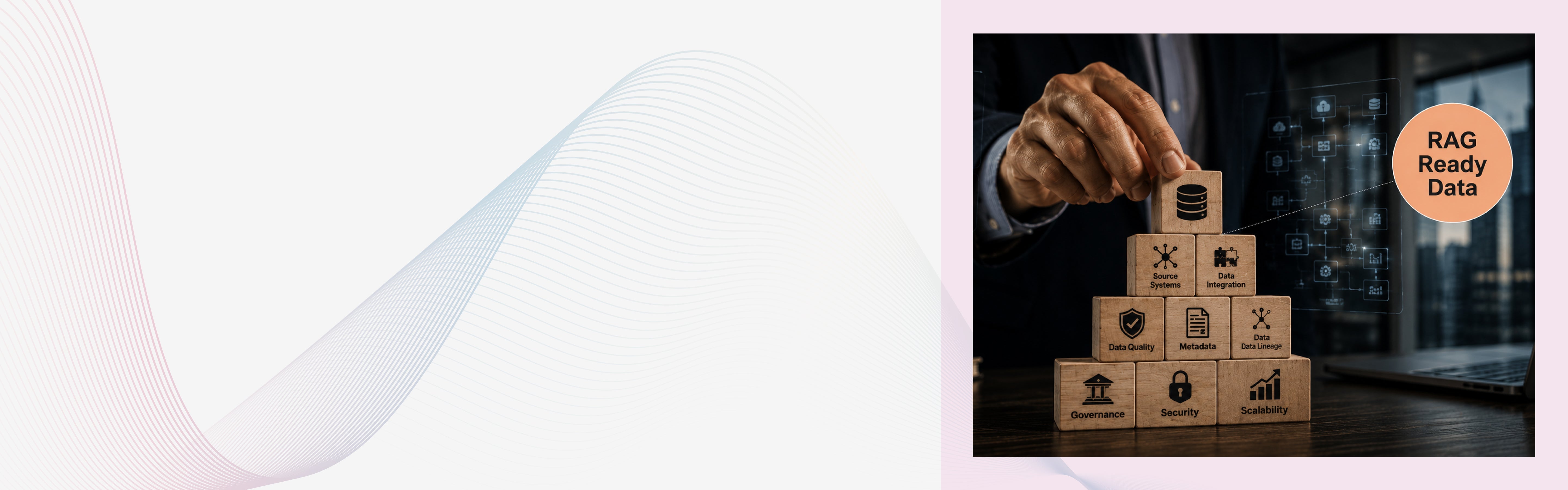
RAG (Retrieval-Augmented Generation) is only as smart as the data you give it. You can pick the best embedding model in the market and configure the most powerful vector store. But if your enterprise data is messy, siloed, untagged, and uncontrolled, your RAG system will confidently deliver wrong answers and sometimes to the wrong people.
In 2026, data preparation has become the most critical and most underestimated phase of any RAG deployment. Moreover, poor data readiness remains the primary reason RAG projects fail before reaching production. This describes that retrieval quality, chunking strategy, and metadata filtering had far greater impact on outcomes than model size alone. In this blog, we will discover the complete data preparation process to help you succeed.
Why Data Preparation Is the Foundation of a Successful RAG System
Most enterprise teams treat data preparation as a pre-launch checklist item. It is not. It is the foundation on which every other layer of your RAG system rests. Think about what Retrieval Augmented Generation actually stands for. It searches a large collection of documents, identifies the most relevant pieces, and passes them to an LLM to generate an answer. If those documents are outdated, duplicate-heavy, poorly structured, or missing critical context, the LLM cannot do its job, no matter how capable it is. The retrieved content becomes noise, not a signal.
No architectural sophistication compensates for poor source data quality. Enterprises that invest in data cleanup, standardization, and metadata enrichment before optimizing chunking strategies consistently outperform those that do not.
The takeaway is simple: getting your data right is not a technical nice-to-have. It is a business necessity, and the enterprise RAG use cases already in production make that case clear.
Preparing Your Enterprise Data for RAG Implementation
Here is the 7-step process to help you prepare your data for RAG implementation in enterprises.
Step 1: Conduct a Data Source Audit
Most large enterprises have knowledge scattered across dozens of systems, be it SharePoint sites, Confluence wikis, Salesforce records, ERP databases, shared drives, and email archives. The first task is to go wide before going deep. Document every system that holds potentially useful information and group sources by type: structured (databases, spreadsheets), semi-structured (XML, JSON, email), and unstructured (PDFs, Word documents, call recordings, images).
Focus first on surfacing your most valuable sources, such as knowledge bases, reports, customer call transcripts, and overlooked internal wikis. Then classify each source by business value, risk, and sensitivity to decide what actually belongs in your RAG index. Tag available data with user roles and sensitivity markers, and determine what can be safely exposed to the LLM versus what requires masking.
Step 2: Clean Your Data Before It Enters the Pipeline
Use content hashing or document fingerprinting tools to identify and consolidate duplicates before ingestion, because feeding duplicate content into your vector index degrades answer quality and inflates retrieval costs.
The most reliable implementation pattern separates two workflows: an offline indexing workflow that prepares data for search, and an online retrieval workflow that answers queries. For the indexing workflow to function well, you need to convert all content into a consistent, clean text format. Use OCR tools like Apache Tika or Amazon Textract for scanned PDFs. Strip navigation and boilerplate from HTML pages. For spreadsheets, convert rows and columns to a readable narrative or structured JSON, since plain spreadsheet dumps often lose context for LLMs.
Before any document goes near your vector database, run it through a PII detection layer. Tools like Microsoft Presidio, AWS Comprehend, or Google Cloud DLP can automatically detect and redact sensitive entities (names, Social Security numbers, account numbers, health records) from documents before they enter your pipeline. In regulated industries, feeding personally identifiable information into a RAG index without proper controls is both a compliance failure and a security risk.
Step 3: Design Your Chunking Strategy
Chunking is the process of breaking cleaned documents into smaller pieces that can be embedded and retrieved individually. It has an outsized impact on retrieval quality and is one of the most commonly underestimated parts of the entire RAG pipeline. Bad chunking produces bad results regardless of model quality, so your strategy needs to match your specific use case.
Hierarchical (parent-child) chunking is the most widely adopted production pattern in 2025 and 2026 because it resolves the fundamental precision-context trade-off. This approach is especially effective for enterprise documents with rich context, like policy documents, legal contracts, and technical manuals.
Optimal chunk size depends on the use case. Always measure on your real data rather than benchmark datasets, because benchmark performance rarely matches real-world retrieval quality in domain-specific enterprise environments.
Step 4: Enrich Your Documents With Metadata
Raw text chunks alone are not enough. Metadata is what makes retrieval intelligent, filtered, and governable. Think of it as the labels your retrieval system uses to find the right document at the right time for the right user. Metadata includes ownership, data domain, sensitivity classification, creation date, and lineage information attached to each chunk, enabling filtered and governed retrieval at scale.
Research is clear on the impact. Metadata-enriched approaches consistently outperform content-only baselines in retrieval precision. Recursive chunking paired with metadata enrichment yielded 82.5% precision in controlled experiments, a significant improvement over naive approaches. When your retrieval system can filter by metadata (for example, returning only documents from the legal domain updated after 2024 that are accessible to the Finance team), it dramatically reduces irrelevant results and speeds up query time.
Every chunk entering your vector index should carry a defined, consistent set of metadata fields. Define your metadata schema before ingestion begins.
Step 5: Set Up Access Controls Before Indexing
Access control is not something you bolt on after launch. It must be designed into your data pipeline from the very beginning. If your vector store does not enforce document-level permissions, any user querying the system could potentially retrieve content they are not authorized to see. Real production incidents involve employees receiving context from executive compensation documents or board meeting minutes because the retrieval layer ignored source access control lists.
Attribute-Based Access Control (ABAC) is best suited to provide flexible, detailed control. It combines user details such as role and clearance with resource labels like owner and sensitivity. Document-scoped policies enhance their precision. Sync group memberships from your identity provider and tag every chunk with sensitivity level and allowed access groups during ingestion.
Audit log everything. Every retrieval should write a record including the user ID, query hash, returned chunk IDs, denied chunk IDs, and the ACL version applied. When a security team asks whether the system ever returned a specific document to a specific user, you need a definitive answer in under ten minutes.
Step 6: Choose and Test Your Embedding Models
After cleaning, breaking them into chunks, and tagging your documents, you have to turn them into vector embeddings. Understanding how these fit into the broader core components of a RAG system helps teams make better architectural decisions at this stage.
Your choice of embedding model sets a long-term coupling between your index and your pipeline. Changing embedding models later requires re-embedding the entire corpus, so treat this decision like a schema migration.
In 2026, enterprises can choose from several categories: OpenAI text-embedding-3-large offers solid performance with simple integration, but data leaves the perimeter. Cohere embed-v4 provides strong multilingual support. Open-source options like nomic-embed, BGE, and E5 can be hosted on-premise for full data control. Domain-specific models fine-tuned for legal, medical, or financial content deliver the best precision but require training investment. For enterprises with sensitive data, a hybrid approach works well.
Use high-precision embeddings tailored for enterprise data and maintain a single source of truth for all RAG-ready content. Always test your chosen model on a representative sample of your actual enterprise data.
Step 7: Plan for Index Freshness and Incremental Updates
Enterprise data changes constantly. Policies get updated, products are revised, and people join or leave. If your RAG index goes stale, the answers it generates become unreliable, and users will stop trusting the system. Index refresh is the mechanism that keeps your RAG application aligned with changing enterprise data, and it needs to be planned before your initial deployment, not after.
Most production systems adopt incremental sync, where only changed objects are reprocessed. Incremental sync requires a change detector using a last-modified marker when it is trustworthy and falling back to content hashing when it is not. If you only run full rebuilds, you will accept long windows of staleness or long maintenance periods, both of which hurt production reliability.
Common Data Preparation Mistakes to Avoid
Even experienced teams fall into predictable traps when preparing enterprise data for RAG. Here are the most common ones:
- Feeding everything without filtering. More data is not always better. Irrelevant and outdated content adds noise that degrades retrieval quality. Filter aggressively.
- Ignoring document structure. Stripping all formatting before chunking loses valuable structural signals (headings, lists, table context) that help the LLM understand where information sits within a document.
- Skipping metadata tagging. Plain text chunks with no metadata lead to retrieval that is fast but unfocused. Metadata is what makes filtered, governed retrieval possible.
- Treating access control as optional. As discussed above, this is a production blocker in any regulated industry. Build RBAC into the pipeline from day one.
- Using a single embedding model for all content types. A model optimized for general web text will underperform on dense legal or financial documents. Match the embedding model to the content domain.
- Not testing on real data. Benchmark datasets tell you very little about how your system will perform on your enterprise's specific documents, language, and query patterns.
Conclusion
This guide explains seven key steps that include auditing sources, cleaning documents, creating chunking strategies, improving metadata, setting access controls, picking embedding models, and deciding how to keep indexes fresh. These steps form the foundation to build a reliable RAG system for production. Businesses taking these steps experience fewer errors, rapid launches, and better compliance. Skipping them often leads to long delays and troubleshooting data issues that could have been avoided.
With a clean, structured, and access-controlled data foundation in place, your next focus shifts to the retrieval mechanics that sit atop it. Enterprises can get the right assistant with our expert AI and ML services. We guide the transition from a solid data foundation to a scalable, production-level RAG system.

