

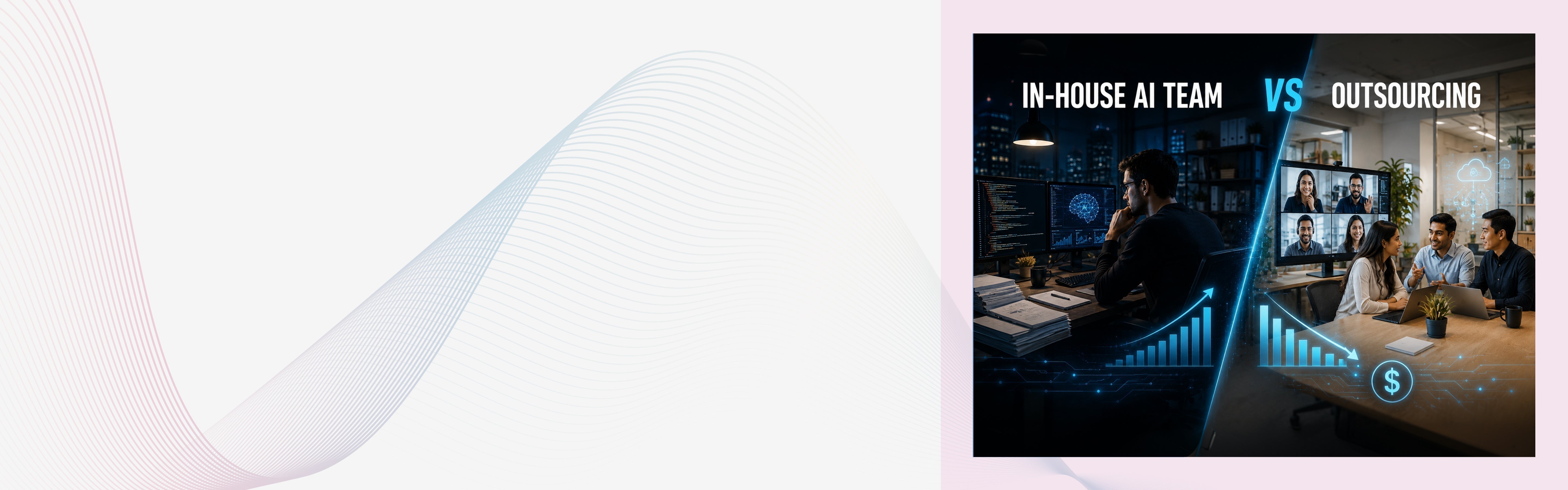
There is a moment almost every CTO or founder hits. You have a real AI use case. You know it can move the needle. But then someone in the room asks: "Do we hire AI developers in-house or do we outsource this?"
It sounds like a simple question. It is not.
The decision touches budget, speed, IP ownership, team culture, long-term maintenance, and how fast you can actually get something into production. And in 2026, with the AI talent market tighter than it has ever been, getting this wrong is more expensive than it used to be. This guide breaks it down with real numbers, not estimates from 2023.
If you are still deciding what kind of AI solution fits your problem, our Custom AI Solution vs Off-the-Shelf AI Tools guide is the right starting point.
The Real Numbers: What It Costs to Hire AI Developers In-House
Let's talk base salary first.
The average salary for an AI developer in the United States is $159,978 per year, with typical pay ranging from $133,528 at the 25th percentile to $195,486 at the 75th percentile, according to Glassdoor data from June 2026.
But salary is the part you already knew about. The part that catches most companies off guard is the loaded cost. A $160,000 base salary hire in the US quickly becomes a $220,000 annual commitment when you add benefits, payroll taxes, recruiting fees, and equipment costs.
Here is what the actual math looks like for a mid-senior AI engineer hire in the US:
| Cost Item | Estimated Annual Amount |
|---|---|
| Base salary (US mid-senior) | $155,000 |
| Employer payroll taxes (~8%) | $12,400 |
| Benefits (health, dental, 401K) | $18,000 |
| Recruiting/agency fee (one-time, ~20%) | $31,000 |
| Onboarding, tools, hardware | $8,000 |
| Training and upskilling | $5,000 |
| Total Year-1 Loaded Cost | ~$229,400 |
The Hiring Timeline Problem
Through traditional local hiring, the average time-to-hire for a senior developer in 2026 is 90 or more days, up from 52 days in 2024. For AI-specific roles, it is often longer. The average time to fill a technical AI role has stretched to 66 days, a full 50% longer than it takes to hire for non-technical positions.
That lag is not just inconvenient. If you are trying to hit a product milestone in Q2 and you start hiring in January, you may not have someone productive until Q3 at the earliest. That is a window your competitors are using. The reason for this is structural. AI talent demand exceeds supply by a ratio of 3.2 to 1, with over 1.6 million open AI positions chasing just 518,000 qualified candidates worldwide.
PwC's 2025 Global AI Jobs Barometer found a 56% wage premium for AI skills, analyzing close to a billion job ads. And ManpowerGroup's 2026 survey found AI skills are now the hardest in the world to hire for, surpassing all other engineering and IT categories. The talent shortage is not a blip. It is structural, and it is getting worse.
The Real Numbers: What Outsourcing AI Development Actually Costs
Outsourcing AI development does not mean handing your idea to a random offshore team and hoping for the best. Done right, it means engaging a specialized agency or dedicated team that owns delivery, accountability, and output quality.
Here is what current market rates look like for AI developers for hire through outsourcing:
| Region | Hourly Rate |
|---|---|
| United States | $120 to $200/hour |
| Western Europe (UK, Germany) | $80 to $150/hour |
| Eastern Europe (Poland, Romania) | $45 to $90/hour |
| India (agency) | $25 to $65/hour |
| Latin America | $40 to $80/hour |
India, as one of the world's leading IT outsourcing destinations, offers a significant cost advantage compared to markets like the United States, the United Kingdom, and Australia, often delivering the same quality of work at 40 to 70 percent lower cost.
To put that in project terms: a project that costs $150,000 with a US team typically costs $30,000 to $50,000 with a senior India-based team doing the same work.
For a dedicated AI development team through a staff augmentation model in India or Southeast Asia, here is a rough monthly budget guide:
| Role | Monthly Cost (India/SE Asia) | US Equivalent |
|---|---|---|
| Junior AI Developer (1-2 yrs) | $1,500 to $2,500 | $8,000 to $12,000 |
| Mid-Level AI Developer (3-5 yrs) | $2,500 to $4,500 | $13,000 to $18,000 |
| Senior AI Engineer (5+ yrs) | $4,500 to $8,000 | $18,000 to $22,000 |
| AI Architect / Lead | $7,000 to $12,000 | $22,000 to $30,000 |
This is the cost arbitrage that capital-efficient companies are actively using. A startup that would spend $500K+ a year building an in-house AI team of three can achieve comparable output at $150K to $200K/year through a well-managed outsourcing engagement.
The Hidden Costs Nobody Puts in the Spreadsheet
When In-House Gets Expensive Fast?
1. Turnover Cost
AI engineers are highly sought after. If your in-house hire leaves after 18 months, you are back to a 90-day search plus a fresh onboarding cycle. The cost of a single turnover at the senior AI level can exceed $100K when you add lost productivity, recruitment, and ramp-up time.
2. Breadth Gap
Hiring one AI developer does not mean you have AI capability. You need data engineers, MLOps specialists, and sometimes domain experts depending on your use case. A single hire rarely covers the full stack. You end up either overloading that person or discovering the gap mid-project.
3. Infrastructure and Tools
GPU compute, model API costs (OpenAI, Anthropic, Google), vector databases, monitoring tools: these add up. Annual operational costs for a production AI system typically run 20 to 40 percent of the initial build cost. An in-house team does not make these costs disappear. It just means you manage them internally.
4. Upskilling Burden
AI is moving fast. The LLM landscape that existed 18 months ago looks very different today. Keeping an in-house team current requires conference budgets, training subscriptions, and dedicated learning time.
When Outsourcing Costs More Than Expected?
1. Scope Creep
Poorly scoped projects on fixed-price contracts have a habit of expanding. If you go into an outsourced engagement without a clearly defined outcome, you will pay for every change through either cost overruns or timeline delays.
2. Communication Overhead
Time-zone gaps and async-first workflows require active management. If your internal team is not organized to work with a remote outsourced partner, the coordination tax is real.
3. IP and Security
For companies handling sensitive data or building core product IP, outsourcing requires careful contract structuring. NDA, IP assignment clauses, and data residency requirements all need to be part of the engagement before a line of code is written.
When to Hire AI Developers In-House?
In-house makes sense when:
- AI is your core product, not a supporting feature. If the entire company is an AI product, in-house ownership is non-negotiable.
- You have long-term, continuous development needs with a stable, well-defined roadmap. Our How to Build an AI Roadmap guide walks through how to structure that planning.
- You are working with sensitive proprietary data that cannot leave internal infrastructure.
- You have already validated your AI use case and need to scale it operationally with dedicated talent.
- You can afford the 90+ day hiring process without stalling your product.
When to Outsource Agency for AI Development?
Outsourcing AI development (agency or bringing in a dedicated AI development team) is the right move when:
- You need to move in 30 to 60 days, not 90+.
- Your AI initiative is a defined project (a specific use case, an MVP, a proof of concept) with a scope you can describe clearly.
- You want access to a range of specialists (ML engineer, NLP expert, MLOps lead) without hiring each one separately.
- You are a startup that needs to prove a concept before committing to full-time headcount.
- You are an enterprise testing a new AI vertical before spinning up an internal center of excellence.
- Budget certainty matters more than internal control.
This is particularly relevant if you have done your AI readiness assessment and identified specific use cases worth tackling, but your internal team does not have the AI specialization to execute.
The Hybrid Model: The Option Most Companies End Up Using
Here is the honest truth: most companies that have successfully deployed AI at scale did not start purely in-house or purely outsourced. They staged it. The pattern that works:
Phase 1 (0 to 6 months): Outsource the Build
Engage a specialist AI agency or dedicated AI team to build the first version. This gets you to a working system fast, without the hiring overhead. Your internal team is involved in scoping, reviewing, and learning.
Phase 2 (6 to 18 months): Transfer and Stabilize
As the system matures, internal engineers are upskilled to own the ML pipeline, model monitoring, and feature development. The outsourced team's involvement gradually reduces.
Phase 3 (18 months+): In-House Ownership
You now have a production AI system with documentation, a trained internal team, and a clear operational model. Outsourcing is used selectively for specialized tasks or to surge capacity when needed.
This model usually delivers production AI capacity within 90 days at roughly 60 percent of the cost of building the same team in-house.
This is the model that a seed-to-Series-B company can actually execute without burning the runway or stalling the roadmap. Once you have decided on the approach, the next step is building the actual implementation plan, which our practical guide on how to implement AI in your business can help you structure.
Quick Comparison Table: In-House vs Outsourcing vs Hybrid
| Decision Factor | In-House | Outsourcing | Hybrid |
|---|---|---|---|
| Speed to start | Slow (90-120 days) | Fast (2-4 weeks) | Fast then stabilizes |
| Year 1 cost (1 senior hire) | $200K-$230K | $60K-$120K | $80K-$150K |
| IP and data control | High | Requires contracts | Moderate to high |
| Breadth of AI skill access | Limited to who you hire | Full team on demand | Grows over time |
| Long-term cost trajectory | Stable | Variable | Decreasing |
| Best for | AI-first products, sensitive data | MVPs, defined projects, speed | Most enterprise use cases |
Conclusion: In-House vs Outsourcing
The real question is: what does your business need to do in the next 90 days, and what is the fastest, lowest-risk path to doing it?
For most companies reading this, the fastest path to AI in production is not a six-month hiring campaign. It is partnering with a team that has done it before, builds the system with you, and transfers ownership on your terms.
At Lucent Innovation, we help businesses move from AI idea to production without the overhead of building a full in-house team from scratch. Our AI development team covers the full delivery lifecycle: from architecture and model development to MLOps, integration, and post-launch support. Whether you are validating a proof of concept or scaling an enterprise AI system, we provide dedicated AI developers for hire who function as an extension of your team from day one.


