

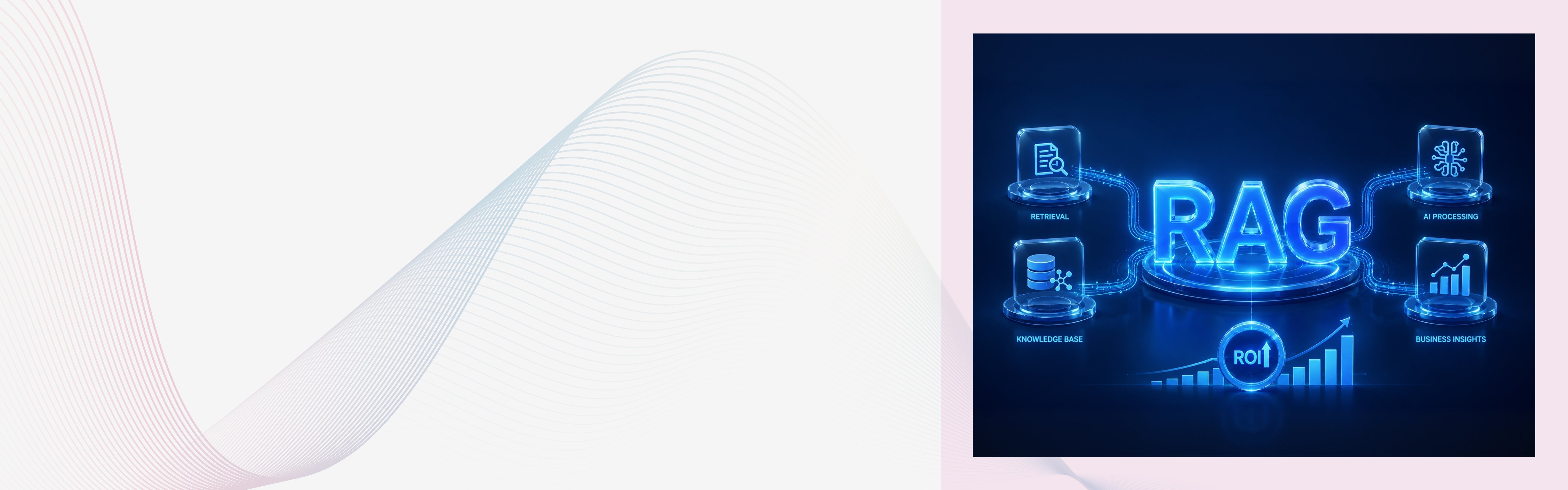
Every enterprise AI conversation eventually arrives at the same question: "What's the return?"
RAG (Retrieval-Augmented Generation) is no exception. In the last two years, I've seen enterprise teams race to adopt RAG architectures and then struggle six months in to justify the continued investment. Not because the technology failed them, but because they never established a clear ROI measurement model before going live.
The problem is not ROI itself. RAG genuinely delivers extraordinary returns: reduced hallucinations, faster employee response times, lower customer support costs, and compound productivity gains. The problem is that most organizations try to measure RAG as they measure traditional software uptime, ticket closure rates, and cost per seat. Those lenses miss 60–70% of the real value.
In this article, we will walk you through a structured framework for measuring the ROI of RAG at every stage of its enterprise lifecycle from initial pilot to full-scale deployment.
Why Measuring RAG ROI Is Different From Traditional Software ROI
Before building the measurement model, it's worth understanding what makes RAG economically unique.
Traditional enterprise software delivers ROI through process automation: you replace a manual step with a system step, you count the hours saved, multiply by cost per hour, and you're done. RAG is fundamentally different because its primary value is augmenting knowledge work, a category that has always been notoriously difficult to quantify.
If you're new to how the technology works, our post on What Is Retrieval-Augmented Generation explains the core mechanics in depth. The short version: RAG connects a large language model to your organization's internal knowledge base, enabling it to answer questions with real-time, enterprise-specific, factual context rather than hallucinating answers from pre-trained data alone.
This grounding in real enterprise data is precisely what creates value and also what makes measurement complex. When a customer service agent uses a RAG-powered assistant to answer a complex billing query in 90 seconds instead of 8 minutes, you gain time savings, accuracy improvements, reduced escalation probability, and customer satisfaction gains, all from a single interaction. Traditional ROI models capture the first item and miss the rest.
A solid RAG ROI framework must account for five value streams simultaneously:
- Time savings: Direct labor productivity gains
- Quality improvements: Reduction in errors, hallucinations, and rework
- Revenue enablement: Faster customer response, higher close rates, better self-service
- Risk reduction: Compliance adherence, reduced liability exposure
- Compound learning: Organizational knowledge becoming more accessible over time
Step 1: Establish Your Baseline Before Deployment
You cannot measure improvement without a starting point. This sounds obvious, yet the majority of enterprise RAG projects skip pre-deployment baseline measurement — and then spend months arguing about whether the gains are real.
Your baseline document should capture the following metrics before your RAG system goes live:
Operational Baselines
| Metric | What to Measure | How to Capture |
|---|---|---|
| Average time-to-answer | How long does it take an employee or agent to find information and respond? | Time-stamp analysis in ticketing, CRM, or chat tools |
| Escalation rate | What % of queries get escalated to a senior resource? | Helpdesk/support platform export |
| First-contact resolution rate | Are issues resolved on the first attempt? | CRM or ITSM reporting |
| Document search time | How long do employees spend searching internal knowledge? | Calendar/time-tracking surveys |
| Error or rework rate | What % of outputs (reports, answers, proposals) require correction? | QA logs, revision tracking |
| Cost per query | Fully loaded cost to answer a knowledge-based question | (Total agent cost ÷ queries handled per period) |
People Baselines
- Average number of hours per week spent searching for information (survey your target user group)
- Percentage of time knowledge workers spend on retrieval vs. synthesis vs. action
- Current onboarding time for new employees reaching full productivity
Studies consistently show knowledge workers spend 20–35% of their workweek searching for information they cannot easily find. If your pre-deployment survey confirms this, you now have a powerful denominator for your ROI calculation.
Step 2: Define Your RAG Cost Structure
Honest ROI measurement requires accounting for the full cost of ownership, not just the LLM API bill. RAG deployments typically carry four cost categories:
1. Infrastructure Costs
- Vector database (Pinecone, Weaviate, Chroma, or Databricks Vector Search): $200–$3,000/month depending on index size
- Embedding compute: Cost to convert your documents into vector embeddings. One-time cost for initial ingestion; recurring cost for new document indexing
- LLM API calls: Typically $0.002–$0.06 per 1,000 tokens depending on model and provider
- Orchestration framework (LangChain, LlamaIndex, Databricks Agent Framework): Usually open-source with compute overhead costs
2. Implementation Costs
- Data preparation, chunking strategy design, and indexing
- Prompt engineering and retrieval pipeline tuning
- Security and access control layer (critical for enterprise RAG)
- Integration with existing applications, portals, and workflows
For a complete breakdown of what this implementation involves architecturally, see our guide on Architecting Enterprise Data for RAG Success.
3. Maintenance Costs
- Ongoing document ingestion pipelines (new content, policy updates, product changes)
- Retrieval quality monitoring and re-ranking tuning
- Model upgrades and prompt versioning
- Index refresh cadence management
4. Hidden Costs of Getting It Wrong
This is the category most CFOs miss in their initial ROI models: the cost of a poorly implemented RAG system. Hallucination rates that aren't brought below acceptable thresholds, retrieval pipelines that return irrelevant chunks, and latency issues that kill user adoption these all generate negative ROI in the form of user distrust, rework, and abandonment.
Understanding the full landscape of these failure modes is why we documented Common Challenges in RAG Implementation separately. Factoring mitigation costs for those challenges into your ROI model from day one makes your projections dramatically more accurate.
Step 3: Quantify the Return — The Five Value Streams in Practice
Value Stream 1: Labor Productivity Gains
This is typically the largest and easiest-to-quantify return from enterprise RAG.
Formula:
Annual Labor Savings = (Hours Saved Per Employee Per Week) × (Employees Using RAG) × (Fully Loaded Hourly Cost) × 50 weeks
Example:
- 200 knowledge workers use RAG daily
- Average time savings: 1.5 hours/week (conservative estimate from baseline survey)
- Fully loaded cost: $45/hour
- Annual savings: 1.5 × 200 × $45 × 50 = $675,000/year
This single calculation often covers the entire cost of a RAG deployment within the first year. And 1.5 hours saved per week is conservative; enterprise RAG deployments frequently report 3–5 hours weekly savings per user once adoption matures.
Value Stream 2: Customer Support Cost Reduction
RAG-powered support systems deliver measurable returns through three levers:
a) Reduced average handle time (AHT)
When agents have RAG-assisted answers available in real time, AHT drops by 25–40% on average. For a contact center handling 10,000 interactions per month at $12/interaction, a 30% AHT reduction = $36,000/month in saved agent cost.
b) Increased first-contact resolution (FCR)
Higher FCR rates reduce the cost of repeat contacts. Every 1% improvement in FCR typically saves contact centers approximately $2.50 per first contact attempt (industry benchmark).
c) Deflection to self-service
A well-tuned RAG-powered chatbot can deflect 20–35% of Tier-1 support queries. At $8–$15 per deflected ticket (industry average), deflection ROI compounds quickly at scale.
Value Stream 3: Revenue Enablement
- Sales enablement:Sales reps with RAG-powered product knowledge assistants respond to prospect questions 3–5x faster. Faster follow-up correlates directly with higher close rates. For an enterprise with 50 reps closing deals at $50K average contract value, even a 2% improvement in close rate = $50K in incremental annual revenue.
- Proposal and content generation: RAG systems trained on past winning proposals, case studies, and pricing data cut proposal creation time from days to hours. Compress the proposal cycle from 5 days to 1.5 days, and your team can pursue 3x more opportunities with the same headcount.
- Customer success retention:CSMs equipped with RAG assistants that surface account history, risk signals, and product usage data renew accounts faster and identify upsell opportunities more reliably.
Value Stream 4: Compliance and Risk Reduction
In regulated industries such as financial services, healthcare, and legal, this value stream often plays a dominant role in ROI calculations.
RAG delivers compliance ROI through:
- Accuracy enforcement: By grounding responses in verified internal policy documents, RAG dramatically reduces the risk of agents giving incorrect regulatory guidance. A single compliance error in financial services can cost $50,000–$500,000 in remediation costs, fines, and reputational damage.
- Audit trail generation:Well-architected RAG systems log every retrieval, every source document referenced, and every response generated. This creates an auditable chain that reduces regulatory review time and simplifies compliance reporting.
- Policy update propagation:When a regulation changes, a traditional knowledge base requires human review of every document that might be affected. A RAG system's retrieval index can be updated centrally, ensuring every downstream query immediately reflects current policy.
Value Stream 5: Organizational Knowledge Retention
This is the hardest to quantify but arguably the most strategically valuable over a 3–5 year horizon.
Every enterprise loses institutional knowledge when employees leave. RAG systems trained on internal documentation, historical decisions, client interactions, and technical specifications create an organizational memory that persists independent of headcount.
Quantification approach:
- What is your average annual employee turnover rate in knowledge-intensive roles?
- What is the estimated productivity ramp time for a replacement (typically 3–9 months)?
- What percentage of that ramp time is spent learning institutional context that RAG could provide immediately?
For an organization with 20% annual turnover in a 100-person knowledge team, losing 20 employees per year at a $80K salary with a 6-month ramp = $800,000/year in lost productivity. If RAG reduces that ramp by 40%, the annual knowledge retention value of RAG is $320,000; a figure that is often overlooked in most ROI calculations.
Step 4: Calculate the ROI — A Worked Example
Let's build a complete ROI model for a mid-size enterprise (500 employees, B2B SaaS company) deploying RAG across their support, sales, and internal knowledge functions.
Costs (Year 1)
| Cost Category | Amount |
|---|---|
| Implementation (data prep, architecture, integration) | $85,000 |
| Vector database and compute infrastructure | $24,000/year |
| LLM API calls (est. 2M calls/month) | $36,000/year |
| Ongoing maintenance and monitoring | $18,000/year |
| Total Year 1 Cost | $163,000 |
Returns (Year 1)
| Value Stream | Conservative Estimate |
|---|---|
| Labor productivity (150 employees × 2hr/week × $40/hr × 50wks) | $600,000 |
| Support cost reduction (AHT -25% on 8,000 tickets/month × $10/ticket) | $240,000 |
| Compliance risk avoidance (estimated 0.5 incidents avoided × $100K avg) | $50,000 |
| Sales enablement (close rate +1.5% × 100 deals × $40K ACV) | $60,000 |
| Knowledge retention (turnover ramp reduction) | $120,000 |
| Total Year 1 Return | $1,070,000 |
Year 1 ROI: ($1,070,000 − $163,000) ÷ $163,000 = 556% Payback period: ~8 weeks
This is a conservative model. Organizations that optimize their RAG pipelines continuously something we document in detail in Optimizing RAG for Maximum Performance typically see Year 2 and Year 3 returns 40–60% higher than Year 1 as adoption deepens, retrieval quality improves, and new use cases are added.
Step 5: Track the Right KPIs Post-Deployment
ROI is not a one-time calculation. It's an ongoing operational discipline. Here are the KPIs that should be on every RAG deployment dashboard:
Retrieval Quality KPIs
- Retrieval Precision@K: Of the top K documents retrieved, what % are actually relevant to the query? Target: >85%
- Answer Faithfulness Score:Does the generated answer accurately reflect what's in the retrieved documents? Target: >90%
- Hallucination Rate: What % of answers contain claims not supported by the retrieved context? Target: <5% and decreasing
- Mean Reciprocal Rank (MRR): Is the most relevant document appearing in top positions? Target: MRR > 0.8
Operational KPIs
- Average query latency: End-to-end time from query submission to answer delivery. Target: <3 seconds for most enterprise use cases
- System availability: Uptime of the retrieval pipeline. Target: >99.5%
- Daily active users (DAU): Leading indicator of adoption and realized value
- Query volume trend:Month-over-month growth indicates expanding use case adoption
Business Outcome KPIs
- Time-to-answer delta: Current vs. baseline comparison (measure monthly)
- Support ticket volume change: Are RAG-powered answers reducing inbound volume?
- Employee NPS on the tool: Subjective but critical for predicting long-term adoption
- Escalation rate trend:Is the system handling more queries without human intervention over time?
Step 6: Build the Business Case for Expansion
Once your initial RAG deployment has 90 days of production data, you have everything you need to build a compelling expansion case. The structure that works best with enterprise leadership follows a three-act format:
Act 1 — What We Deployed and Why
Brief recap of the initial use case, the problem it addressed, and the total investment made.
Act 2 — What the Data Shows
Three to five quantified outcomes from your KPI dashboard. Use the time-to-answer delta and labor savings as your anchor numbers; they're the most visceral and easiest for non-technical stakeholders to grasp.
Act 3 — What Expansion Unlocks
Show the marginal ROI curve: the cost of expanding from one department to three is rarely 3x the initial cost, because infrastructure is already in place. Use this to demonstrate that the ROI per dollar invested increases with scale. For context on the full spectrum of enterprise use cases that expansion can address, our post on RAG Use Cases for Enterprises provides a detailed breakdown of 12+ deployment scenarios across industries.
Common ROI Measurement Mistakes to Avoid
Before closing, here are the measurement traps that undermine even well-designed RAG ROI models:
1. Measuring only cost savings, not revenue impact
Cost reduction is visible and easy to attribute. Revenue enablement is diffuse and harder to isolate. Build your model to capture both, even if the revenue numbers carry wider confidence intervals.
2. Using vanity metrics as proof of ROI
"Our RAG system answered 50,000 queries last month" tells a CFO nothing. "Our RAG system reduced average response time by 67%, saving 2,100 labor hours last month valued at $94,500" tells them everything.
3. Ignoring the cost of low adoption
A RAG system that sits at 15% adoption delivers 15% of its potential ROI. Track DAU religiously. If adoption is lagging, the bottleneck is almost never the technology; it's onboarding, trust, or UX. Solve the adoption problem before claiming the model is not delivering ROI.
4. Calculating ROI only at launch
RAG ROI compounds. A system that delivers 400% ROI in Year 1 often delivers 600–800% ROI in Year 2 as the knowledge base matures and use cases expand. Build rolling 12-month and 36-month ROI tracking into your measurement cadence.
5. Forgetting attribution complexity
If your sales team's close rate improves, some of that improvement is attributable to RAG, some to better marketing, some to market conditions. Use controlled pilots and A/B groups where possible to isolate the RAG contribution. Where isolation is not possible, use conservative attribution weights (40–60% of observed improvement attributed to RAG) and document your assumptions explicitly.
Conclusion
Measuring the ROI of RAG is not about building a perfect model; it's about building a credible, consistent one that improves with each measurement cycle. Start with a rigorous baseline. Capture all five value streams, not just the most obvious ones. Build your KPI dashboard before go-live. And revisit the numbers every quarter, because RAG systems compound in value as they mature.
Organizations that gain the most value from RAG are those that measure deliberately, iterate systematically, and expand strategically, not necessarily those that deploy the fastest. The technology is powerful. The measurement discipline is what converts that power into business outcomes that your board, your CFO, and your customers can all see.
At Lucent Innovation, we've helped enterprises across retail, financial services, and technology industries design, deploy, and continuously optimize RAG architectures that deliver measurable, defensible ROI from Day 90 onward. Whether you're building your first RAG business case, troubleshooting a deployment that hasn't yet hit its targets, or ready to scale from a pilot to an enterprise-wide rollout, our expert Data Engineering team is ready to help.


