

Most teams do not choose the wrong Python framework because they misunderstood a feature list. They choose the wrong one because they start with the framework before defining the product.
A prototype begins as six endpoints. Then user accounts arrive. Then operations needs an internal dashboard. Then permissions, audit history, background jobs, and third-party integrations appear. The framework that felt pleasantly lightweight in month one can become a pile of architecture decisions by month twelve.
The opposite failure happens too. A team chooses the largest framework "for scale," then spends months working around conventions for a service that only accepts JSON, calls two models, and returns a response.
I would not start by asking which framework is fastest. I would start by asking what the application must own, what traffic it must handle, and how much architecture the team wants the framework to provide. That decision changes everything that follows.

Flask vs FastAPI vs Django 2026: The Decision at a Glance
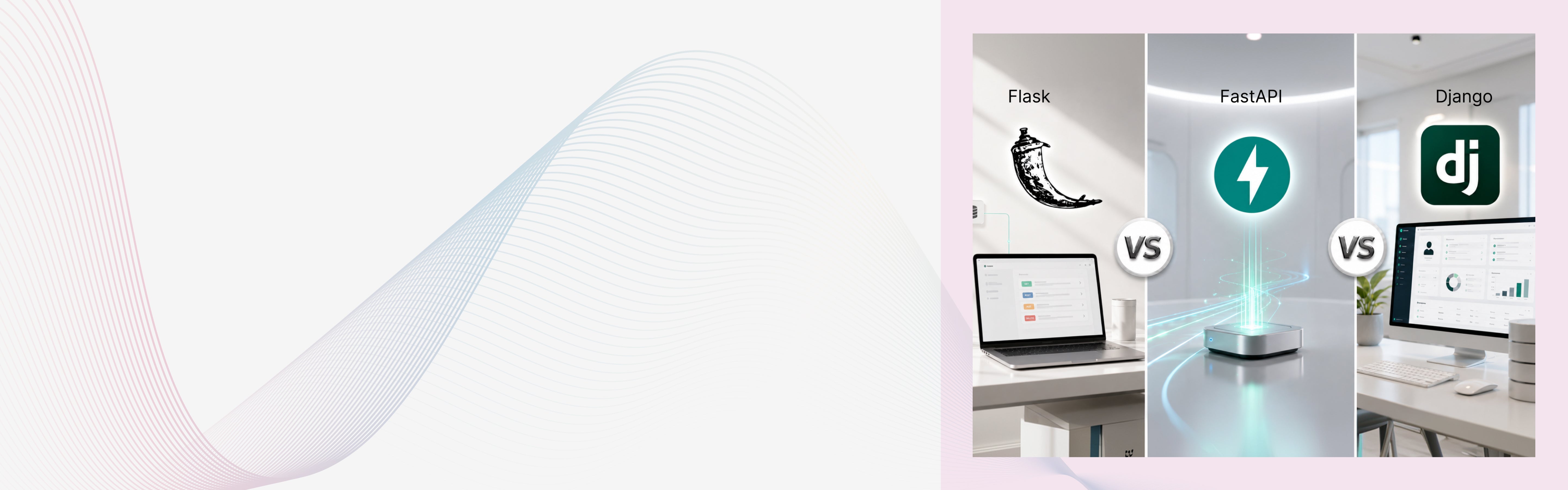
The practical answer is direct: Django is the strongest default for full business applications, FastAPI for API-first products, and Flask for deliberately small or highly customized services.
The 2026 context matters. Python 3.14.6 is the current stable Python release. Flask is on the 3.1 series, and Django 6.0 is the current stable series. FastAPI continues to center its design on type hints, validation, OpenAPI, and ASGI.
| Decision dimension | Flask | FastAPI | Django |
|---|---|---|---|
| Best fit | Focused custom services | APIs and service backends | Full business applications |
| Architecture | Team-defined | API-opinionated | Framework-led |
| Async | Supported, not async-first | Async-first ASGI | Async-capable under ASGI |
| Admin and auth | Add separately | Add separately | Included |
| API validation and docs | Add separately | Built in | Usually add an API layer |
| Main risk | Architecture drift | Rebuilding product features | Carrying features you do not need |
The table is only the starting point. The choice becomes clearer when the decisions are made in the order the product will experience them.
Decision 1: Choose the Shape of the Product Before the Framework
Choose Django for a product, FastAPI for an API surface, and Flask for a focused service unless the requirements clearly point elsewhere.
A business product usually needs users, permissions, relational data, back-office workflows, and operational screens. Django includes authentication and a model-driven admin intended for trusted internal management. FastAPI is strongest at the API boundary, where type hints drive validation, schemas, and interactive documentation. Flask is strongest when the service has a narrow job and the team intentionally wants control over the rest of the stack.
The failure I see most often is choosing for the first sprint. Write down the capabilities likely to exist 12 months from now. Once the product shape is clear, decide how much structure the framework should own.
Decision 2: Decide How Much Structure the Framework Should Own
Choose the framework whose defaults remove decisions your team does not want to make repeatedly.
Django owns more: models, migrations, authentication, permissions, forms, sessions, admin, middleware, and project conventions. Flask owns less, which is valuable for unusual architectures, but your team must still choose validation, ORM, authentication, project structure, and background-job patterns. FastAPI sits between them. It is structured at the API boundary through request models, validation, dependency injection, and documentation, while leaving much of the internal architecture open.
I normally use one rule: let the framework own commodity decisions and spend custom engineering on business-specific problems.
With ownership clear, the next question is whether the workload actually benefits from async concurrency.
Decision 3: Match the Concurrency Model to the Workload
Choose FastAPIwhen high-concurrency I/O is central. Choose Django when async is useful inside a broader business application. Do not choose Flask simply because you plan to add async def.
FastAPI is built on ASGI and allows synchronous and asynchronous path operations to coexist. Django supports async views and an async request stack under ASGI, plus async ORM interfaces for many operations. Flask supports async views, but its own design documentation explains that it does not use the same async-first execution model as ASGI frameworks.
Async will not fix slow queries or CPU-heavy inference. Measure waiting time, compute time, and external dependencies separately. Then ask what business features you would otherwise have to build.
Decision 4: Price Built-In Features and Long-Term Maintenance
Djangowins when the product needs common business capabilities because those features have a real delivery and maintenance cost outside the framework.
For a 10-endpoint inference API, Django's broader feature set may be unnecessary. For B2B SaaS with accounts, roles, internal operations, relational workflows, and queued work, built-in structure can shorten the path to a stable system. Django 6.0 also includes a task abstraction for defining and queuing background work, although production execution still requires worker infrastructure.
The smaller framework is not always the smaller system. Flask and FastAPI can implement the same capabilities, but your team owns more integration choices.
Now compare that architecture with the team that must maintain it.
Decision 5: Match the Framework to the Team and Deployment Model
The best framework is the one your team can operate consistently after the original architect leaves.
Flaskrewards architectural discipline. FastAPI feels productive to teams comfortable with modern Python typing and API design, but large codebases still need domain boundaries, configuration rules, observability, and test strategy. Django reduces structural variation, provided the team is willing to use its conventions rather than fight them.
Deployment should follow the workload. Flask needs a production WSGI or appropriate production setup, FastAPI typically runs through an ASGI server, and Django can use WSGI or ASGI. All three can scale, but the first bottleneck is often an unindexed query, repeated inference, a slow external API, or poor caching rather than the framework itself.
That leaves one final decision: where the framework sits in the wider system.
Decision 6: Decide How AI and Data Workloads Fit the System
Choose FastAPI when the AI or data service is itself the product boundary. Choose Django when AI is one capability inside a larger application. Choose Flask when the integration is narrow and deliberately custom.
A model endpoint, retrieval service, document processor, or internal data API often maps naturally to FastAPI. A SaaS application using recommendations or AI-assisted workflows may still fit Django better because the business system also owns users, permissions, operations, and relational data. Flask remains useful for thin adapters around existing Python libraries.
The mistake is forcing the whole product into the framework that best serves one component. A Django application can call a FastAPI model service.
The framework decision is now complete. The remaining risk is implementation.
Common Mistakes to Avoid With Flask vs FastAPI vs Django
Mistake: Choosing From Benchmark Charts
Hello-world throughput does not represent a production workload. Test authentication, database access, caching, serialization, and external calls before making performance claims.
Mistake: Treating Flask as Easy Instead of Minimal
Flask is easy to start because it makes few decisions. Define project structure, validation, authentication, database boundaries, and extension rules before the codebase grows.
Mistake: Choosing FastAPI and Forgetting Product Operations
A strong API layer does not automatically provide staff workflows, permission administration, content tools, or support screens. Operations teams are users too.
Mistake: Choosing Django and Ignoring Its Conventions
Django becomes expensive when a team selects it for built-in structure and then bypasses that structure everywhere. Depart from conventions only for a measured requirement.
Mistake: Mixing Sync and Async Without Understanding the Boundary
Async syntax does not automatically improve throughput. Classify expensive work as CPU-bound, synchronous I/O, or asynchronous I/O, then design the request path accordingly.
Mistake: Optimizing for Hypothetical Scale
Do not build a distributed system for traffic that may never arrive. Choose for the next credible stage of the business, then keep boundaries clear enough to change later.
Summary and Next Steps
Start with product shape. Choose Django for full business applications with substantial user, data, and operations workflows. Choose FastAPI when the system is fundamentally an API, especially around AI, data, mobile clients, or concurrent network calls. Choose Flask when the service is intentionally focused and architectural freedom creates real value.
Then evaluate built-in requirements, concurrency, team capability, deployment, and long-term ownership. Only after that should benchmarks influence the decision.
The central rule is simple: framework size should match product responsibility.
For businesses building Python systems with multiple integrations, AI components, or long product roadmaps, the framework choice deserves architectural attention before development accelerates.


